🔧 Step-by-Step Answer Walkthrough For Easy Level
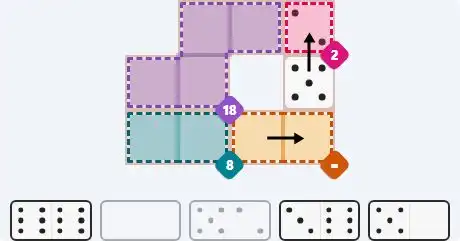
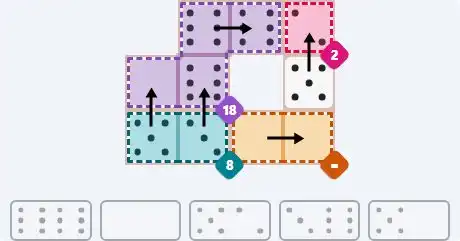
The equals region at [2,2]–[2,3] needs two matching pips. [6|6] would work in isolation but leaves an unsolvable sum-18 — there's no combination from the remaining pieces that reaches 18 in those four cells. [0|0] is the only double that fits. It goes horizontally in the bottom-right.
Cell [0,3] is a solo sum constraint — it has to hold pip 2. Only [5|2] has a 2-pip face, so it goes vertically at col 3: pip 5 at row 1 (unconstrained empty region), pip 2 at row 0 (sum=2 ✓).
The sum-8 region covers [2,0] and [2,1]. These two cells are each the bottom half of separate vertical dominoes — they're not part of the same piece. You need two pip values that add to 8. From what's left: [5|0] and [3|6] give 5+3=8.
[5|0] goes vertically at col 0: pip 5 at row 2, pip 0 at row 1. [3|6] goes vertically at col 1: pip 3 at row 2, pip 6 at row 1. Both pip-at-bottom values land in the sum-8 region — 5+3=8 ✓.
Only [6|6] is left, and it fits perfectly at row 0 cols 1–2. The sum-18 region gets 6+6 from this piece and 0+6 from the bottoms of the two vertical dominoes — 6+6+0+6=18 ✓. Done.
🔧 Step-by-Step Answer Walkthrough For Medium Level
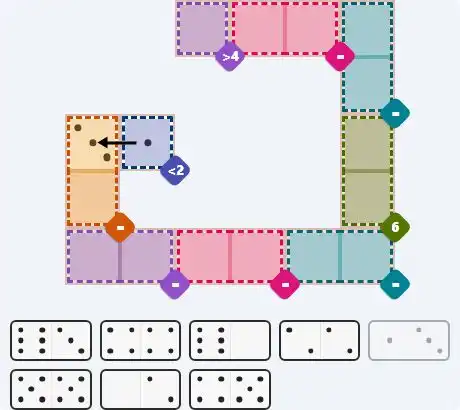
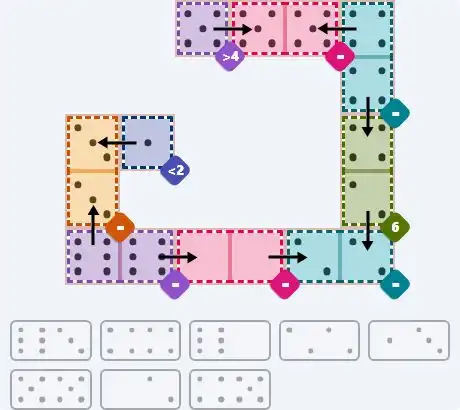
Cell [2,1] has a < 2 constraint — pip must be 0 or 1. That cell is only reachable by a horizontal domino paired with [2,0]. From the available set, [1|3] places 1 at [2,1] ✓, with 3-pip landing at [2,0]. No other domino with a 0 or 1 face can go here without breaking what comes next.
The equals constraint at [2,0]–[3,0] means [3,0] also has to be 3. Cell [3,0] is covered by a vertical domino running down to [4,0]. From the remaining pieces, [6|3] is the one that places 3 at [3,0] — it goes vertically with 3 at row 3 and 6 at row 4.
[4,0]=[4,1] by the equals constraint, so [4,1] must also be 6. [4,1] is the left cell of a horizontal domino. [6|0] is the match — 6-pip at col 1, 0-pip at col 2.
[4,2]=[4,3] equals constraint, and [4,2]=0 just set. So [4,3]=0. [0|2] horizontal at [4,3]–[4,4] puts 0 at col 3 (equals=0 ✓) and 2-pip at col 4.
[4,4]=[4,5] equals, and [4,4]=2. So [4,5]=2. [2|2] goes vertically at col 5, rows 3–4: both cells pip 2. [3,5]=2 and [4,5]=2 ✓.
Sum-6 covers [2,5]+[3,5]. [3,5]=2 is locked. So [2,5]=4. The vertical domino at col 5 rows 1–2 must show 4 at row 2. [4|4] does it — both pips 4, and 4+2=6 ✓.
[0,5]=[1,5] equals, and [1,5]=4 just placed. So [0,5]=4. The horizontal domino at row 0 covering cols 4–5 must show 4 at col 5. [4|5] reversed: 4-pip at col 5, 5-pip at col 4.
[0,3]=[0,4] equals, and [0,4]=5 from the previous step. So [0,3]=5. [5|5] at row 0 cols 2–3: both 5s. [0,2]=5>4 ✓, [0,3]=5 closes equals ✓. Puzzle done.
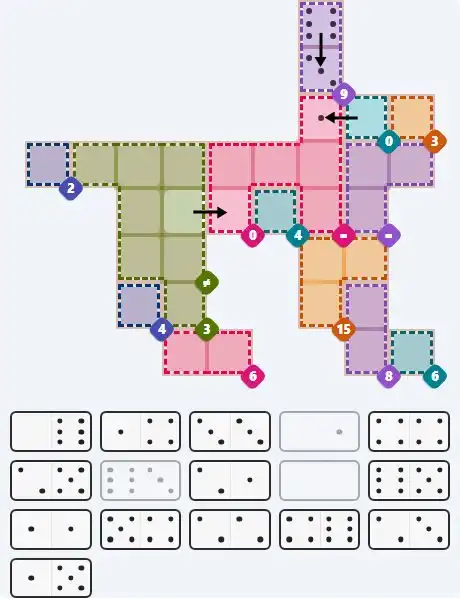
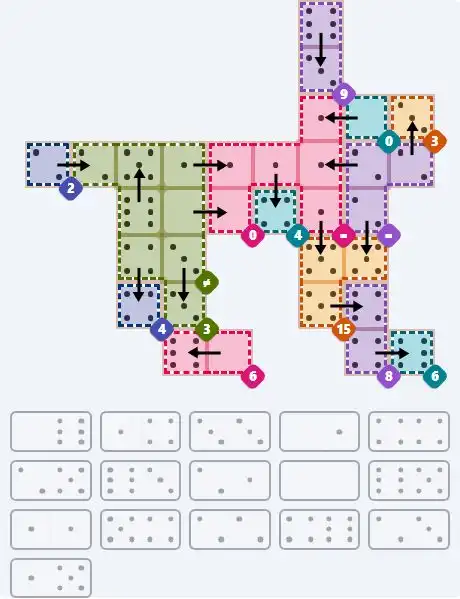
🔧 Step-by-Step Answer Walkthrough For Hard Level
Cell [2,7] must hold pip 0 — no other value is legal. [0|1] is the domino that covers it: 0-pip at [2,7] ✓, 1-pip at [2,6], which happens to sit inside the five-cell equals region.
Cell [2,8] must be pip 3. [2|3] covers [2,8]–[3,8]: 3-pip at [2,8] ✓, 2-pip at [3,8] — that 2 will matter shortly for the equals region below.
Cell [3,0] must be pip 2. [2|2] goes horizontally at [3,0]–[3,1]: 2-pip at [3,0] ✓, 2-pip at [3,1] (entering the unequal block).
Cell [4,4] must be pip 0. [0|0] spans [4,3]–[4,4] horizontally — both cells pip 0. [4,3] also lands in the unequal block.
Cell [4,5] must be pip 4. [1|4] goes vertically [3,5]–[4,5]: 1-pip at [3,5] (entering the five-cell equals region) and 4-pip at [4,5] ✓.
Cells [0,6]+[1,6] need to sum to 9. [6|3] is the only domino that hits 9 on its own. It goes vertically: 6-pip at [0,6], 3-pip at [1,6].
The equals region [2,6],[3,4],[3,5],[3,6],[4,6] forces one common value. [2,6]=1 from Step 1, [3,5]=1 from Step 5. All five must equal 1. Three cells remain: [3,6], [3,4], [4,6]. [2|1] horizontal [3,7]–[3,6] places 1 at [3,6]. [1|1] horizontal [3,3]–[3,4] places 1 at [3,4]. [1|5] vertical [4,6]–[5,6] places 1 at [4,6] and 5-pip at [5,6].
[3,7]=2 (from [2|1] in Step 7), [3,8]=2 (from Step 2). So [4,7] also must be 2. [2|5] vertical [4,7]–[5,7]: 2-pip at [4,7] ✓, 5-pip at [5,7].
[5,6]+[5,7]+[6,6] has to reach 15. [5,6]=5 and [5,7]=5 are already set. So [6,6]=5. [5|4] goes horizontally [6,6]–[6,7]: 5-pip at [6,6] ✓, 4-pip at [6,7].
[6,7]=4 from Step 9. Sum-8 needs [7,7]=4. [4|6] horizontal [7,7]–[7,8]: 4-pip at [7,7] ✓, 6-pip at [7,8].
[7,8]=6 from Step 10 — sum=6 ✓. Separately, [7,3]+[7,4] must sum to 6. [0|6] goes horizontal [7,4]–[7,3]: 0-pip at [7,4], 6-pip at [7,3] (0+6=6 ✓).
Cell [6,2] must be pip 4. [4|4] goes vertically [5,2]–[6,2]: 4-pip at both. [5,2]=4 enters the unequal block.
Cell [6,3] must be pip 3. [3|3] goes vertically [5,3]–[6,3]: 3-pip at both. [5,3]=3 enters the unequal block.
The unequal block [3,1],[3,2],[3,3],[4,2],[4,3],[5,2],[5,3] needs seven distinct pip values. So far: [3,1]=2, [3,3]=1, [4,3]=0, [5,2]=4, [5,3]=3. Remaining cells [3,2] and [4,2] need the two missing values — 5 and 6. [6|5] vertical [4,2]–[3,2]: 6-pip at [4,2], 5-pip at [3,2]. All seven cells hold different values ✓. Puzzle solved.
💬 Community Discussion
Leave your comment