NYT Pips Hints & Answers for June 18, 2026

Jun 18, 2026

🚨 SPOILER WARNING

This page contains the final **answer** and the complete **solution** to today's NYT Pips puzzle. If you haven't attempted the puzzle yet and want to try solving it yourself first, now's your chance!

Click here to play today's official NYT Pips game first.

Want hints instead? Scroll down for progressive clues that won't spoil the fun.

SEE ALSO:

🎲 Today's Puzzle Overview

Ian Livengood’s easy puzzle is a gem of constraint economy. By seeding the grid with two single‑cell sum‑5 regions at [1,1] and [1,5], he instantly locks those cells to pip 5—a bold move that sets off a chain reaction. Adjacent greater‑than‑2 cells at [1,0] and [0,3] then demand values above 2, while a pair of equals regions tie together [0,2]‑[1,2] and [1,3]‑[1,4] in a tidy parallel. The result is a quick but elegant solve that feels like flipping switches.

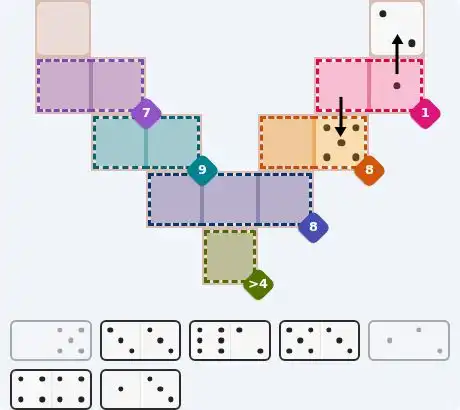
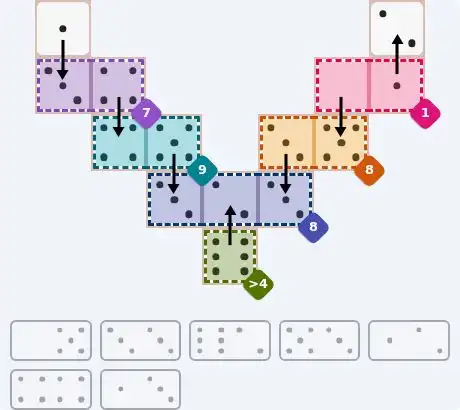
Rodolfo Kurchan’s medium grid takes a more symphonic approach. He places two empty cells at opposite corners, freeing the outer edges for flexible domino placement. The real engine, however, is the row‑1 sum‑1 region that forces a 0 and a 1 into tight quarters. From that spark, a sum‑7 pair and a sum‑9 pair create a counterbalance across the board, while a central three‑cell sum‑8 cluster in row 3 acts as a keystone. Kurchan’s signature is the gentle unveiling of the central [4,3] greater‑than‑4 cell, which becomes the final lock.

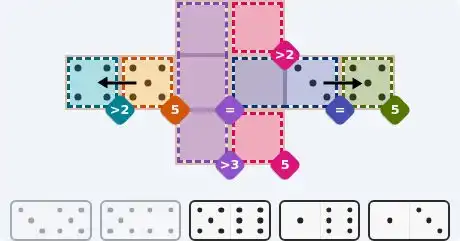
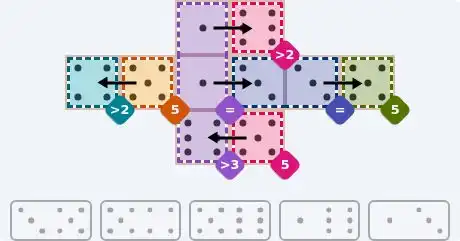
Kurchan’s hard puzzle for today is a towering edifice of equality. A four‑cell equals region on row 2, spanning columns 2 through 5, forces all four to the same pip—and the only viable answer is 0. That zero bloc cascades into a less‑than‑3 column at left and a less‑than‑4 cell at [2,6], ultimately demanding a 3 there. On the right, a massive five‑cell equals region (encompassing parts of rows 3 and 4) shimmers as a 2, linking up with a sum‑6 vertical pair and a sum‑10 base. In this NYT Pips hard, Kurchan constructs a latticework of equalities that must be untangled strand by strand.

💡 Progressive Hints

Try these hints one at a time. Each hint becomes more specific to help you solve it yourself!

💡 Hint 1: Spot the beacons
Seek out single‑cell sum regions. They act like beacons, forcing a precise pip without any partners.
💡 Hint 2: Anchor at the sum‑5 cells
The two sum‑5 cells in row 1, columns 1 and 5, are your starting line. Their neighbors (a greater‑than‑2 and an equals pair) will narrow the available dominoes drastically.
💡 Hint 3: The full chain
Place the [5,4] domino at [1,0]‑[1,1] to satisfy the sum‑5 at [1,1] and the greater‑2 at [1,0]. Then the [3,5] domino goes to [1,4]‑[1,5] for the other sum‑5, creating an equals chain at [1,3]‑[1,4] that forces the [1,3] domino. With [0,2] matching [1,2]=1, the [1,6] domino covers the top, and [5,6] cleans up the bottom row.
💡 Hint 1: Find the tightest sum
Look for the tightest sum constraint—the sum‑1 region in the upper right will only allow one combination of pips, and it will force a domino containing a 0.
💡 Hint 2: The 0 and 1 unroll
The sum‑1 cells are at [1,5] and [1,6]. The only way to get a 0 into the mix is the [0,5] domino; place it so [1,5]=0, [2,5]=5. Then [1,6] must be a 1, which comes from the [1,2] domino placed at [1,6]‑[0,6].
💡 Hint 3: Building the center
With the right side set, the central three‑cell sum‑8 region at [3,2]‑[3,4] defines the middle. The equals‑value domino [3,3] fills [2,4]‑[3,4], making both 3. The sum‑9 pair [2,1]‑[2,2] then takes [5,3] as 5 and 3, while the sum‑7 pair left of it grabs [4,4] (4 and 4). The bottom greater‑4 cell [4,3] ends as 6 from the [6,2] domino, and the empty corners take the remaining [1,3] domino for [0,0]‑[1,0] with 1 and 3.
💡 Hint 1: The equality backbone
The puzzle’s backbone is a pair of large equals regions. One spans four cells, the other five cells. They will force identical pips across those clusters, and the surrounding constraints will dictate exactly which pip that must be.
💡 Hint 2: Zero in on the four‑cell region
Focus first on the four‑cell equals region on row 2, columns 2–5. The only pip that can satisfy all four cells without breaking adjacent sum/less‑than limits is 0. Once you set them all to 0, the less‑than‑3 region at [2,0]‑[3,0] and the less‑than‑4 cell at [2,6] become highly restricted.
💡 Hint 3: Edges snap into place
With the row‑2 zero line, the [2,6] cell must be less than 4, so it can be 0,1,2,3. But it’s adjacent to the zero region, so the only domino that fits is [3,0] (3,0), giving [2,6]=3 and [2,5]=0. For the column‑0 less‑than‑3 region, the [2,0] domino (2,0) fills [2,0]=2, [3,0]=0.
💡 Hint 4: The five-cell wave
Now look at the five‑cell equals region covering [3,3]‑[3,5] and [4,3]‑[4,4]. The surrounding cells and the sum‑6 vertical pair at column 2 force that equals‑value to be 2. Use the [2,2] domino (2,2) for the 2s in that region, and the [1,4] domino (1,4) plus [5,2] (5,2) for the sum‑6 cells.
💡 Hint 5: Unlock the full grid
Complete solution path: Lock the zero region with [0,0] at [2,3]‑[2,4] and [3,0] at [2,5]‑[2,6] (2,5=0, 2,6=3). Place [2,0] at [2,0]‑[3,0] (2,0). The five‑cell equals becomes 2s: [2,2] at [3,3]‑[3,4], [2,1] at [3,5]‑[3,6] (3,5=2, 3,6=1), [2,6] at [4,3]‑[5,3] (4,3=2, 5,3=6), [5,2] at [4,4]‑[4,5] (4,4=2, 4,5=5). The equals‑1 region [3,6]‑[3,7]‑[4,6]‑[4,7] gets 1s: [1,3] at [4,7]‑[5,7] (4,7=1), [1,0] at [3,7]‑[3,8] (3,7=1, 3,8=0), [5,1] at [5,6]‑[4,6] (5,6=5, 4,6=1). Sum‑6 column 2: [0,5] at [2,2]‑[3,2] (2,2=0, 3,2=5), [1,4] at [4,2]‑[5,2] (4,2=1, 5,2=4, sum=6). Top/left: equals [0,0]‑[1,0] forces 3s: [4,3] at [0,0]‑[0,1] (0,0=3, 0,1=4), [6,3] at [1,0]‑[1,1] (1,0=3, 1,1=6). Sum‑10 [0,1]‑[0,2]: [6,5] at [0,2]‑[1,2] (0,2=6, 1,2=5). Greater‑10 [1,1]‑[1,2] checks out (11).

🎨 Pips Solver

Jun 18, 2026

Click a domino to place it on the board. You can also click the board, and the correct domino will appear.
Final Answer & Complete Solution For Hard Level

The key to solving today's hard puzzle was identifying the placement for the critical dominoes highlighted in the starting grid. Once those were in place, the rest of the puzzle could be solved logically. See the final grid below to compare your solution.

Starting Position & Key First Steps
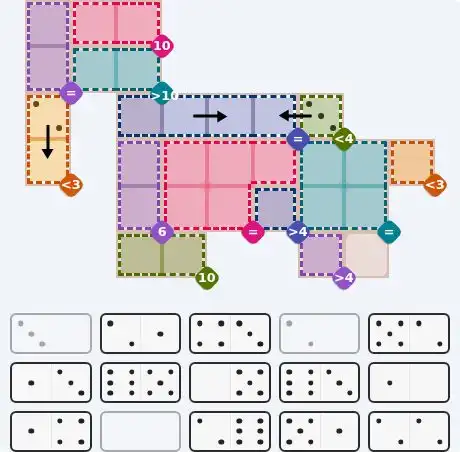
Pips hint for June 18, 2026 – hard level puzzle grid with critical first placements and strategy

This image shows the initial puzzle grid for the hard level, with a few critical first placements highlighted.

Final Answer: The Solved Grid for Hard Mode
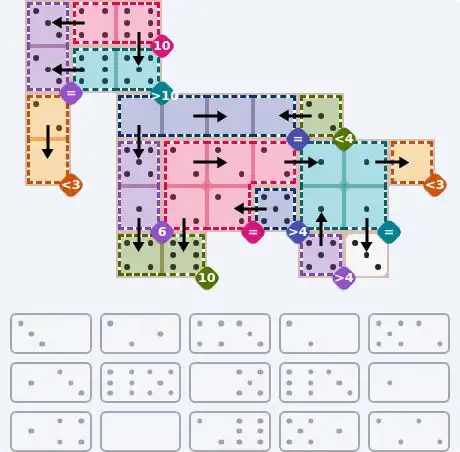
NYT Pips June 18, 2026 hard puzzle full solution grid showing final answer with hints

Compare this final grid with your own solution to see the correct placement of all dominoes.

🔧 Step-by-Step Answer Walkthrough For Easy Level

1
Step 1: Forced single cells
Identify the forced singles. The single‑cell sum‑5 regions at [1,1] and [1,5] require a pip of exactly 5. No other value can go there, so mark both as 5.
2
Step 2: The first anchor pair
Cell [1,0] is greater‑than‑2, so it must be 3,4,5, or 6. Since it’s adjacent to [1,1]=5, the only domino that links a 5 with a number >2 is [5,4] (5 and 4). Place it horizontally: [1,0]=4, [1,1]=5.
3
Step 3: The second sum‑5 and equals chain
Cell [1,5]=5 must pair with a neighbor; the only remaining domino containing a 5 is [3,5] (3 and 5). Place it vertically: [1,4]=3, [1,5]=5. The equals region at [1,3]‑[1,4] now forces [1,3]=3. The domino [1,3] (1 and 3) fits perfectly at [1,2]‑[1,3], giving [1,2]=1.
4
Step 4: Top and bottom resolution
The equals pair [0,2]‑[1,2] forces [0,2]=1. The remaining domino [1,6] (1 and 6) goes to [0,2]‑[0,3], with [0,3] satisfying its greater‑2 as 6. Finally, the greater‑3 cell [2,2] and sum‑5 cell [2,3] take the [5,6] domino, placing [2,2]=6 and [2,3]=5.

🔧 Step-by-Step Answer Walkthrough For Medium Level

1
Step 1: The sum‑1 starter
The sum‑1 region on row 1, columns 5‑6, must be filled with a 0 and a 1. Since dominos don't contain 0 and 1 together, one domino must supply the 0 and another the 1. The only 0‑bearing domino is [0,5] (0,5). Place it vertically so [1,5]=0, [2,5]=5.
2
Step 2: The 1 finds its home
Now [1,6] needs a 1. The domino [1,2] (1,2) can deliver it. Place [1,2] vertically with [1,6]=1, [0,6]=2. The empty cell at [0,6] happily accepts the 2.
3
Step 3: The central sum‑8 region
The sum‑8 region [2,4]‑[2,5] must total 8, and we already have [2,5]=5, so [2,4] must be 3. The [3,3] domino (3,3) is the only one that can place a 3 there while also providing a 3 for the three‑cell sum‑8 region [3,2]‑[3,4]. Place [3,3] vertically: [2,4]=3, [3,4]=3.
4
Step 4: Completing the middle band
The three‑cell sum‑8 region now has [3,4]=3, so the remaining two cells [3,2] and [3,3] must sum to 5. The pair [2,2]‑[3,2] will be filled by [5,3] (5,3), with [3,2]=3 and [2,2]=5. This forces [3,3]=2, which comes from the [6,2] domino placed horizontally at [4,3]‑[3,3], setting [4,3]=6 (satisfying the greater‑4).
5
Step 5: Left side and empty corners
The sum‑9 region [2,1]‑[2,2] has [2,2]=5, so [2,1]=4. The [4,4] domino (4,4) can cover [1,1]‑[2,1] with [1,1]=4, [2,1]=4. Then the sum‑7 region [1,0]‑[1,1] forces [1,0]=3. The remaining [1,3] domino (1,3) fits at [0,0]‑[1,0] with [0,0]=1, [1,0]=3. All empty cells resolved.

🔧 Step-by-Step Answer Walkthrough For Hard Level

1
Step 1: The zero cascade
Force the four‑cell equals region [2,2]‑[2,5] to zero. If it were 1 or higher, adjacent sum‑6 and less‑than constraints would break. Therefore all are 0. Use domino [0,0] at [2,3]‑[2,4] and [3,0] at [2,5]‑[2,6] ([2,5]=0, [2,6]=3 because it’s less‑than‑4).
2
Step 2: The less‑than‑3 column
The region [2,0]‑[3,0] must sum <3. The domino [2,0] (2,0) is the only one with a 2 and a 0 that fits; place it at [2,0]=2, [3,0]=0.
3
Step 3: The five‑cell equals turns to 2
The region [3,3]‑[3,5] and [4,3]‑[4,4] all share a pip. Adjacent constraints force it to 2. Place [2,2] at [3,3]‑[3,4] (both 2). Next, [2,1] at [3,5]‑[3,6] gives [3,5]=2, [3,6]=1. For [4,3] and [4,4], use [2,6] at [4,3]‑[5,3] ([4,3]=2, [5,3]=6) and [5,2] at [4,4]‑[4,5] ([4,4]=2, [4,5]=5).
4
Step 4: The equals‑1 region
The equals region [3,6]‑[3,7]‑[4,6]‑[4,7] now inherits [3,6]=1, so all become 1. Place [1,3] at [4,7]‑[5,7] (4,7=1, 5,7=3), [1,0] at [3,7]‑[3,8] (3,7=1, 3,8=0, satisfying less‑than‑3), and [5,1] at [5,6]‑[4,6] (5,6=5, 4,6=1).
5
Step 5: Sum‑6 column and top‑left
Column‑2 sum‑6: [0,5] at [2,2]‑[3,2] gives [3,2]=5, and [1,4] at [4,2]‑[5,2] gives [4,2]=1, [5,2]=4 (5+1=6). Top‑left: equals [0,0]‑[1,0] forces same pip. [4,3] at [0,0]‑[0,1] sets [0,0]=3, [0,1]=4; [6,3] at [1,0]‑[1,1] sets [1,0]=3, [1,1]=6. Sum‑10 [0,1]‑[0,2]: [6,5] at [0,2]‑[1,2] gives [0,2]=6, [1,2]=5. Greater‑10 [1,1]‑[1,2]=11 checks out.

💡 Pro Tips for Similar Puzzles

Start with Constraints
Always begin with the most constrained regions - sum regions with small numbers or tight spaces.
Use Equal Regions
Use "equal" regions as anchors - they eliminate many possibilities quickly.
Work Systematically
Let the rules guide your placement rather than guessing randomly.
Double-Check
Verify each region's rules are satisfied before moving to the next.

🎓 Keep Learning & Improve