NYT Pips Hint, Answer & Solution for January 13, 2026

Jan 13, 2026

🚨 SPOILER WARNING

This page contains the final **answer** and the complete **solution** to today's NYT Pips puzzle. If you haven't attempted the puzzle yet and want to try solving it yourself first, now's your chance!

Click here to play today's official NYT Pips game first.

Want hints instead? Scroll down for progressive clues that won't spoil the fun.

🎲 Today's Puzzle Overview

Tuesday, January 13, 2026 brings a fresh NYT Pips puzzle—one that feels especially suited for sharing ideas, comparing notes, and solving side by side with the community.

Mid-January is often when routines settle back in, and today’s puzzle fits that rhythm perfectly: calm on the surface, clever once you dig in.

Edited by Ian Livengood, this lineup strikes a thoughtful balance between accessibility and subtle misdirection. The regions guide you just enough to get started, while still leaving room for discussion, second looks, and those rewarding “oh, that’s why” moments. It’s the kind of grid where swapping a Pips Hint or checking a friend’s logic can completely change how you see the board.

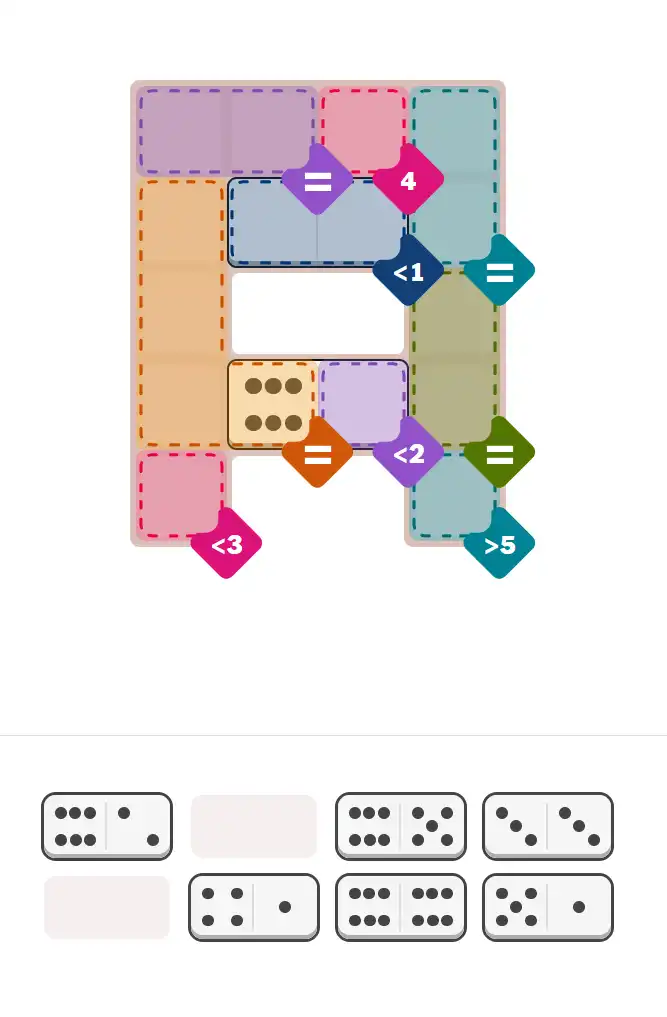
The Easy puzzle (ID 517), constructed by Ian Livengood, is a welcoming entry point. Compact regions and clean constraints make it ideal for sharing an early pips hint today, spotting forced placements, or helping a newer solver gain confidence without giving everything away.

The Medium puzzle (ID 541)—also by Livengood—adds a layer of depth, with equals regions stretching across the grid and less-than clues that reward patience and careful coordination. This is where discussion really starts to matter.

To finish the set, the Hard puzzle (ID 565) by Rodolfo Kurchan leans into collaboration, featuring layered sums and wide equals zones that practically invite solvers to break the problem down together, one insight at a time.

Whether you’re trading hints, double-checking a solution, or simply enjoying the shared experience of working through a tricky section, January 13, 2026 feels like a day designed for NYT Pips community problem-solving—and for turning small insights into satisfying breakthroughs.

Written by July

Puzzle Analyst – Nikki

💡 Progressive Hints

Try these hints one at a time. Each hint becomes more specific to help you solve it yourself!

💡 Hint #1 - A piece of cake
Enjoy it
💡 Hint #1 - Identify single-supply pips to force early commitments
Scan the domino set for pips that appear in only one domino. When a region demands that value (like a lone 4), it immediately constrains nearby equal regions and limits which dominoes can carry shared pips such as 1.
💡 Hint #2 - Use strict less-than regions to eliminate almost everything
Very small inequality targets (<1) are powerful. They usually force zeros, and when zero pips are scarce, the exact domino placement becomes unavoidable, clearing uncertainty fast.
💡 Hint #3 - Chain inequalities into equals regions
Once a low-value region is fixed, propagate the result outward. Less-than regions often dictate which pips must be excluded elsewhere, allowing equal regions to collapse to a single value.
💡 Hint #4 - Let high-threshold regions absorb the largest pips
Greater-than regions naturally attract the largest remaining pips. Assign those first, then use the leftovers to resolve adjacent equal and exact-value regions with confidence.
💡 Hint #5 - Close with the only remaining equal option
When all other regions are satisfied, the final equal region usually has only one domino left that can repeat the required value, making the last placement trivial.
💡 Hint #1 - Count-based elimination to lock key regions
Start by scanning all available dominoes and counting how many halves exist for critical pips (like 6, 5, 3, 2, 1). When a region target (such as sum 11) cannot be formed by any single domino, it immediately forces a specific combination (6+5 here), narrowing the entire grid early.
💡 Hint #2 - Anchor high-sum regions to force surrounding placements
Once a large target region is fixed, use its boundary to lock neighboring regions. Placing a forced domino between Purple 4 and Green 11 reduces remaining high-pip options, which then cascades into smaller regions like Yellow 4 and Purple 0.
💡 Hint #3 - Reserve scarce pips for mandatory regions
When only a few dominoes contain a high pip (like 6 or 5), check which regions absolutely require them. Eliminate placements that would starve another region, and you’ll often deduce both a greater-than region and an equal region at the same time.
💡 Hint #4 - Use equals regions to define exact pip values
Equal regions become powerful once the remaining pool is small. Identify which pip value can still repeat enough times, then place those dominoes confidently while satisfying adjacent less-than, exact, or zero regions.
💡 Hint #5 - Solve paired targets together to avoid dead ends
When two regions depend on the same remaining domino set (like Purple >4 and Light Blue 8), treat them as a pair. Assign the minimum needed pips to satisfy the exact-sum region first, then place the leftovers into the inequality region.
💡 Hint #6 - Finish with the last forced sum
At the end, only one domino fits the final sum constraint. With all other regions resolved, the remaining domino naturally completes the grid without ambiguity.

🎨 Pips Solver

Jan 13, 2026

Click a domino to place it on the board. You can also click the board, and the correct domino will appear.
Final Answer & Complete Solution For Hard Level

The key to solving today's hard puzzle was identifying the placement for the critical dominoes highlighted in the starting grid. Once those were in place, the rest of the puzzle could be solved logically. See the final grid below to compare your solution.

Starting Position & Key First Steps
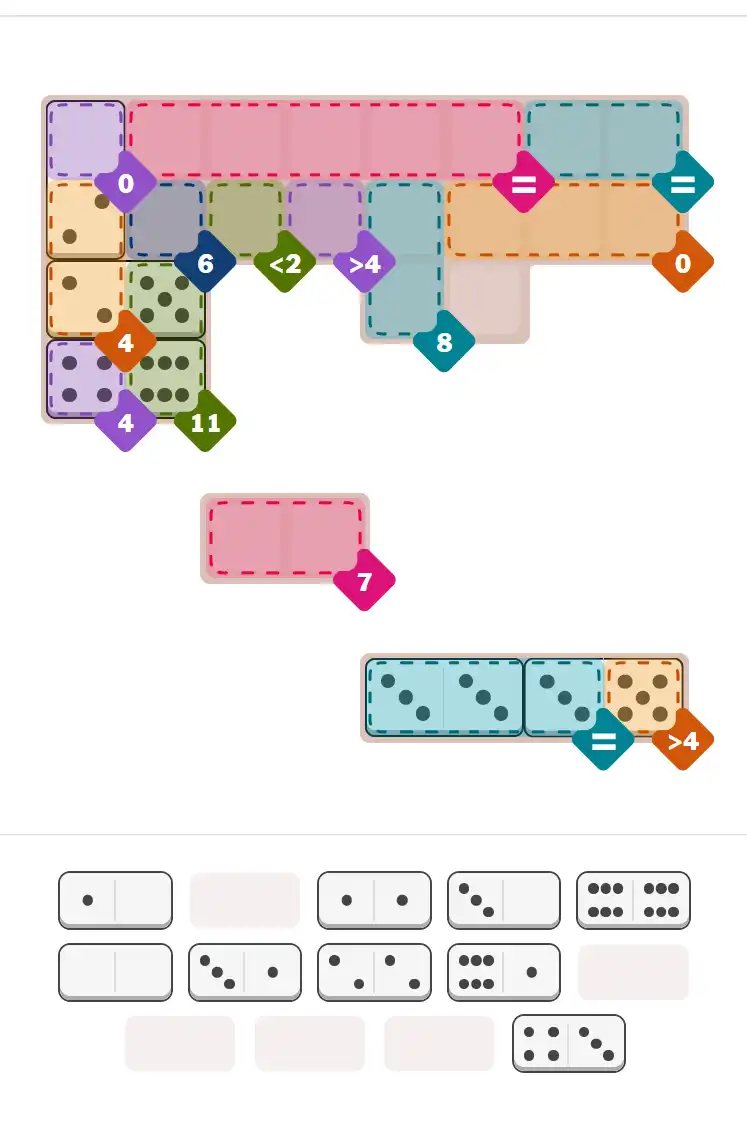
Pips hint for January 13, 2026 – hard level puzzle grid with critical first placements and strategy

This image shows the initial puzzle grid for the hard level, with a few critical first placements highlighted.

Final Answer: The Solved Grid for Hard Mode
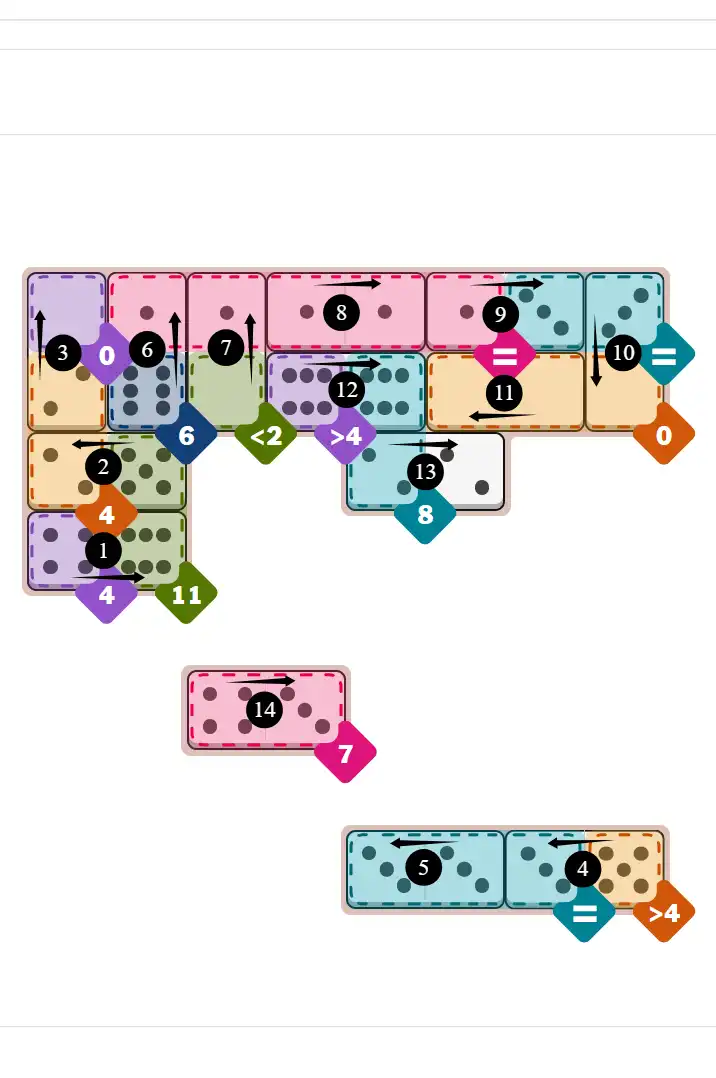
NYT Pips January 13, 2026 hard puzzle full solution grid showing final answer with hints

Compare this final grid with your own solution to see the correct placement of all dominoes.

🔧 Step-by-Step Answer Walkthrough For Easy Level

1
Step 1
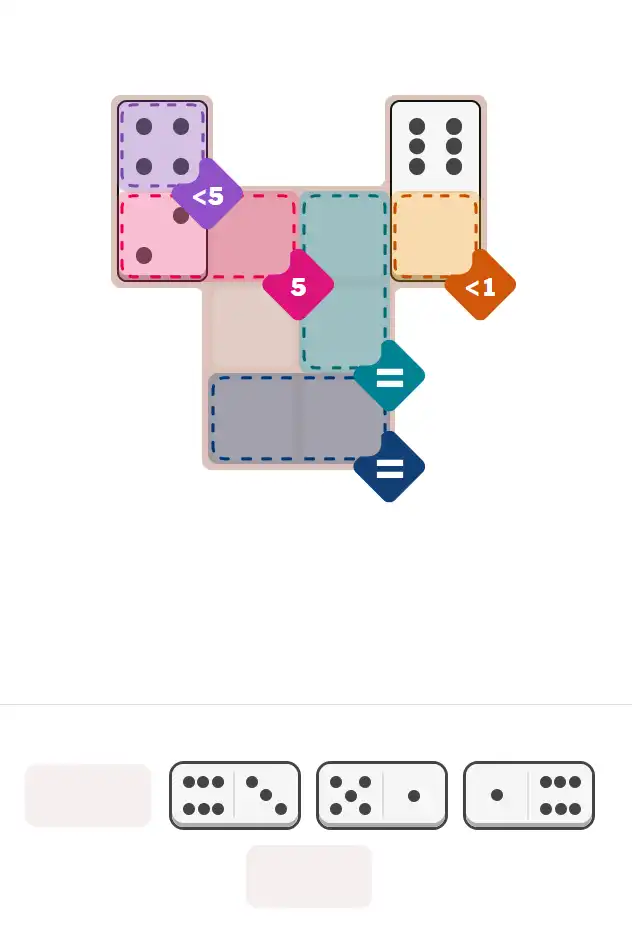
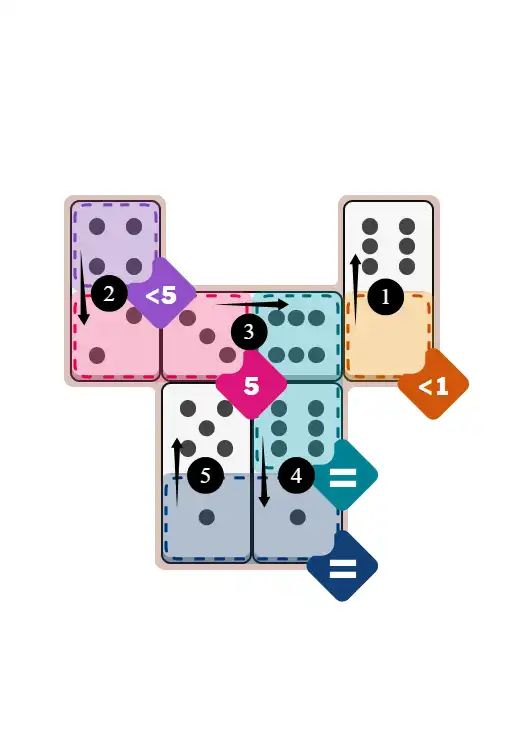
Dominoes Include: [6-3], [6-1], [6-0], [5-1], [4-2].
2
Step 2: Yellow <1 --(Arrows ①)
Confirmed by neighboring region and step 1 and relative position. Only one domino with 0 pips (6-0). The answer is 0-6 (0 into Yellow <2 region, 6 up into blank), placed vertically.
3
Step 3: Purple <4 + Red 5 + Light Blue Equal + Blue Equal --(Arrows ②③④⑤)
Confirmed by neighboring region and remaining dominoes (6-3, 6-1, 5-1, 4-2). The domino halves in Red 5 region must be 2+3. The domino halves in Light Blue Equal region must be 6. The domino halves in Blue Equal region must be 1. The answer is 4-2 (4 into Purple <4 region), placed vertically; 3-6, placed horizontally; 6-1, placed vertically; 1-5 (5 up into blank), placed vertically.

🔧 Step-by-Step Answer Walkthrough For Medium Level

1
Step 1
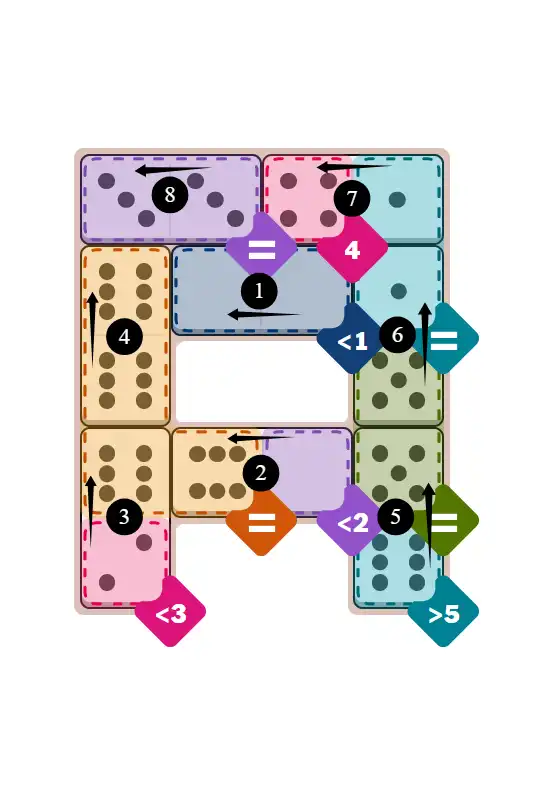
Dominoes Include: [6-6], [6-5], [6-2], [6-0], [5-1], [4-1], [3-3], [0-0]. Only one domino with 4 pips (4-1) for Red 4 region. Therefore, the domino halves in Purple Equal region or Light Blue Equal region must be 1 and only 2 dominoes with 1 pips (5-1, 4-1).
2
Step 2: Blue <1 --(Arrows ①)
Confirmed by neighboring region and step 1 and relative position. The domino halves in this region must be 0+0, only 3 domino halves that contain 0 pips (6-0, 0-0). The answer is 0-0 (whole domino), placed horizontally.
3
Step 3: Purple <2 + Red <3 + Yellow Equal --(Arrows ②③④)
Confirmed by neighboring region and step 1 and step 2 and remaining dominoes. The domino halves in Purple <2 region must be 0. The domino halves in Yellow Equal region must be 6. The answer is 0-6, placed horizontally; 2-6 (2 into Red <3 region), placed vertically; 6-6, placed vertically.
4
Step 4: Light Blue >5 + Green Equal + Light Blue Equal + Red 4 --(Arrows ⑤⑥⑦)
Confirmed by neighboring region and remaining dominoes (6-5, 5-1, 4-1, 3-3). The domino halves in Green Equal region must be 5. The domino halves in Light Blue Equal region must be 1. The answer is 6-5 (6 into Light Blue >5 region), placed vertically; 5-1, placed vertically; 1-4 (4 into Red 4 region), placed horizontally.
5
Step 5: Purple Equal --(Arrows ⑧)
The answer is 3-3, placed horizontally.

🔧 Step-by-Step Answer Walkthrough For Hard Level

1
Step 1
Dominoes Include: [6-6], [6-4], [6-1], [5-3], [5-2], [4-3], [3-3], [3-1], [3-0], [2-2], [2-0], [1-1], [1-0], [0-0]. No domino sum to be 11, so the domino halves in Green 11 region must be 6+5. Only 4 domino halves that contain 2 pips, only 5 domino halves that contain 1 pips, only 6 domino halves that contain 3 pips.
2
Step 2: Purple 4 + Green 11 + Yellow 4 + Purple 0--(Arrows ①②③)
The domino halves in Green 11 region must be 6+5. [4-6] must placed in the boundary between Purple 4 region and Green 11 region. The answer is 4-6, placed horizontally. Only 2 dominoes left that contain 6 pips (6-6, 6-1), only 2 dominoes left that contain 5 pips (5-3, 5-2). Confirmed by all left regions and step 1 and relative position. The domino halves in Yellow 4 region must be 2+2. The answer is 5-2, placed horizontally; 2-0, placed vertically.
3
Step 3: Yellow >4 + Bottom Light Blue Equal --(Arrows ④⑤)
Confirmed by neighboring region and remaining dominoes. Only two dominoes left that contain 6 pips (6-6, 6-1), [6-1] must required for Blue 6 region, [6-6] can't placed in the boundary between Yellow >4 region and Bottom Light Blue Equal region (not more enough 6 pips for Bottom Light Blue Equal). Only one domino left that contain 5 pips (5-3) can fit Yellow >4 region. Therefore, the domino halves in Bottom Light Blue Equal region must be 3. The answer is 5-3 (5 into Yellow >4 region), placed horizontally; 3-3, placed horizontally.
4
Step 4: Red Equal + Blue 6 + Green <2 + Top Light Blue Equal + Yellow 0--(Arrows ⑥⑦⑧⑨⑩⑪)
Confirmed by neighboring region and remaining dominoes (6-6, 6-1, 4-3, 3-1, 3-0, 2-2, 1-1, 1-0, 0-0). The domino halves in Red Equal region must be 1. The domino halves in Top Light Blue Equal region must be 3. The answer is 6-1 (6 into Blue 6 region), placed vertically; 0-1 (0 into Green <2 region), placed vertically; 1-1, placed horizontally; 1-3, placed horizontally; 3-0 (0 into Yellow 0 region), placed vertically; 0-0 (into Yellow 0 region), placed horizontally.
5
Step 5: Purple >4 + Light Blue 8 --(Arrows ⑫⑬)
Confirmed by neighboring region and remaining dominoes (6-6, 4-3, 2-2). The domino halves in Light Blue 8 region must be 6+2. The answer is 6-6 (one 6s into Purple >4 region), placed horizontally; 2-2 (one 2s right into blank), placed horizontally.
6
Step 6: Red 7 --(Arrows ⑭)
The answer is 4-3 (whole domino), placed horizontally

🎥 NYT Pips Solutions & Strategy | Tuesday, January 13, 2026 (Easy 517 · Medium 541 · Hard 565)

Focusing on why each domino placement works

💡 Pro Tips for Similar Puzzles

Start with Constraints
Always begin with the most constrained regions - sum regions with small numbers or tight spaces.
Use Equal Regions
Use "equal" regions as anchors - they eliminate many possibilities quickly.
Work Systematically
Let the rules guide your placement rather than guessing randomly.
Double-Check
Verify each region's rules are satisfied before moving to the next.

🎓 Keep Learning & Improve