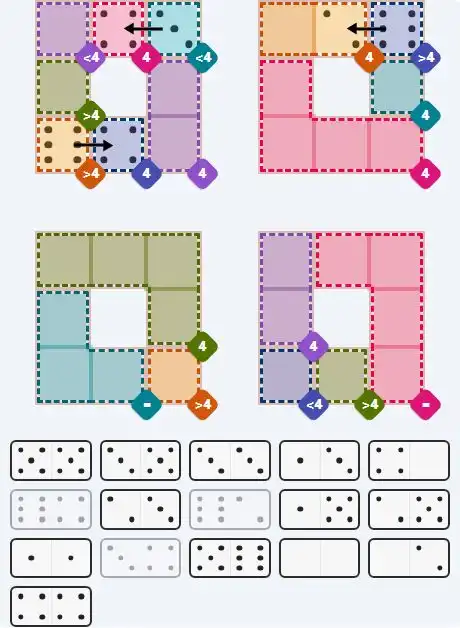
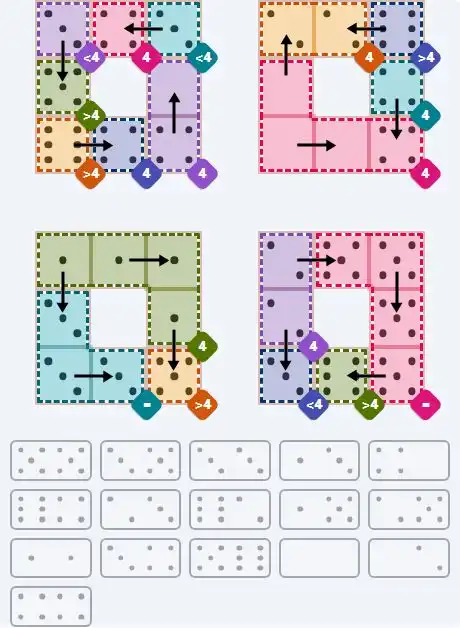
🔧 Step-by-Step Answer Walkthrough For Easy Level
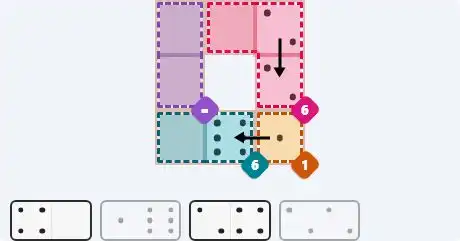
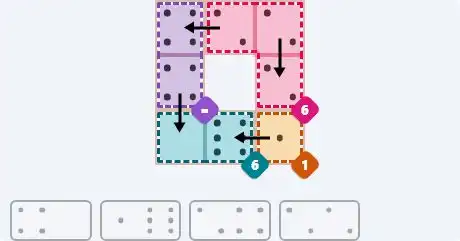
The cell at [2,2] carries a single-cell sum=1 constraint — it must hold exactly 1. Of your four dominoes, [1–6] is the only one with a 1. Place it horizontally: 1 at [2,2] and 6 going left to [2,1].
The pair sum=6 at [2,0] and [2,1] now has [2,1]=6 confirmed. Subtract: [2,0] must be 0. The [4–0] domino delivers: place it vertically with 4 at [1,0] and 0 dropping to [2,0].
The equals constraint at [0,0] and [1,0] requires both cells to match. [1,0]=4, so [0,0] must also be 4. The [2–4] domino threads the top row: place it horizontally with 2 at [0,1] and 4 at [0,0].
One domino and one region remain. The sum=6 at [0,1]+[0,2]+[1,2] has [0,1]=2 already placed. The remaining two cells need to sum to 4 — that means both must be 2. Place [2–2] vertically with 2 at [0,2] and 2 at [1,2]. Final check: 2+2+2=6 ✓. Puzzle complete.
🔧 Step-by-Step Answer Walkthrough For Medium Level
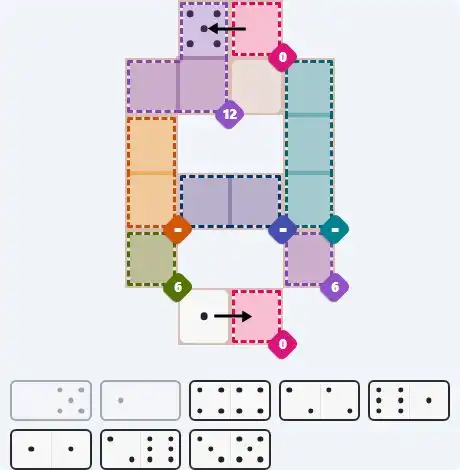
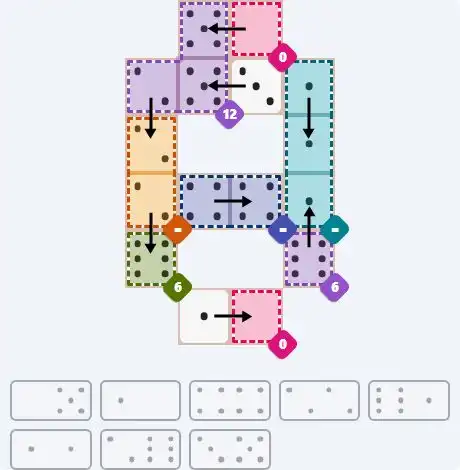
Cell [0,2] is a single-cell sum=0 region — it must hold 0. The [0–5] domino places 0 there and 5 going right to [0,1]. Set that aside and find the other zero: cell [5,2] is also a sum=0 region. The [1–0] domino places 1 at [5,1] and 0 at [5,2].
The sum=12 region covers [0,1], [1,0], and [1,1]. [0,1]=5 from step 1, so the other two cells need to total 7. The [3–5] domino contributes: place it vertically with 3 at [1,2] (empty ✓) and 5 at [1,1]. Now [1,0] needs to be 2. The [2–2] domino fits: place it vertically with 2 at [1,0] and 2 at [2,0]. Sum check: 5+2+5=12 ✓.
The equals region at [2,0] and [3,0] needs both cells to match. [2,0]=2, so [3,0]=2. The [2–6] domino slots in vertically: 2 at [3,0] and 6 at [4,0]. The single-cell sum=6 at [4,0] confirms: 6=6 ✓.
The single-cell sum=6 at [4,3] forces 6 there. Place [6–1] vertically: 6 at [4,3] and 1 at [3,3]. That 1 anchors the three-cell equals region at [1,3], [2,3], and [3,3] — all must be 1. Place [1–1] vertically with 1 at [1,3] and 1 at [2,3]. ✓
One domino and one region remain: [4–4] and the equals region at [3,1]–[3,2]. A double domino in an equals region — it's a perfect match. Place [4–4] horizontally: 4 at [3,1] and 4 at [3,2]. Puzzle complete.
🔧 Step-by-Step Answer Walkthrough For Hard Level
Three lone sum=4 cells sit across the board, each requiring exactly 4. Cell [0,1]: place [3–4] horizontally with 3 at [0,2] (less-than-4 ✓) and 4 at [0,1]. Cell [2,1]: place [6–4] horizontally with 6 at [2,0] (greater-than-4 ✓) and 4 at [2,1]. Cell [1,6]: place [4–4] vertically with 4 at [1,6] and 4 at [2,6].
Cell [0,6] has a greater-than-4 constraint — it needs 5 or 6. The [6–2] domino places 6 at [0,6] (✓) and 2 at [0,5]. The pair sum=4 at [0,4]+[0,5] now has [0,5]=2, so [0,4]=2. Place [0–2] vertically with 0 at [1,4] and 2 at [0,4].
The sum=4 region at [1,4]+[2,4]+[2,5]+[2,6] already has [1,4]=0 and [2,6]=4. The remaining two cells [2,4] and [2,5] must total 0 — both are 0. Place [0–0] horizontally: 0 at [2,4] and 0 at [2,5]. Sum check: 0+0+0+4=4 ✓.
Sum=4 at [1,2]+[2,2]: place [4–0] vertically with 0 at [1,2] and 4 at [2,2]. 0+4=4 ✓. Left column: [0,0] needs less-than-4 and [1,0] needs greater-than-4. The [3–5] domino threads both: 3 at [0,0] (less-than-4 ✓) and 5 at [1,0] (greater-than-4 ✓).
The equals region at [5,0], [6,0], and [6,1] needs all three cells to match. Working backward from available dominoes: place [1–3] vertically with 1 at [4,0] and 3 at [5,0]. Place [3–3] horizontally with 3 at [6,0] and 3 at [6,1]. All three cells equal 3. ✓
The sum=4 region covers [4,0], [4,1], [4,2], and [5,2]. [4,0]=1 from step 5, so the other three cells need 3 total — all must be 1. Place [1–1] horizontally with 1 at [4,1] and 1 at [4,2]. Place [1–5] vertically with 1 at [5,2] and 5 at [6,2] (greater-than-4 ✓). Sum check: 1+1+1+1=4 ✓.
The equals region at [4,5], [4,6], [5,6], and [6,6] needs all four cells to share the same value. Place [5–5] vertically with 5 at [4,6] and 5 at [5,6]. Place [2–5] horizontally with 2 at [4,4] and 5 at [4,5]. Place [5–6] vertically with 5 at [6,6] and 6 at [6,5] (greater-than-4 ✓). Equals check: all four cells show 5. ✓
Sum=4 at [4,4]+[5,4]: [4,4]=2 from step 7, so [5,4]=2. Place [2–3] vertically with 2 at [5,4] and 3 at [6,4] (less-than-4 ✓). 2+2=4 ✓. Every constraint satisfied — puzzle complete.
💬 Community Discussion
Leave your comment