NYT Pips Hints & Answers for April 25, 2026

Apr 25, 2026

🚨 SPOILER WARNING

This page contains the final **answer** and the complete **solution** to today's NYT Pips puzzle. If you haven't attempted the puzzle yet and want to try solving it yourself first, now's your chance!

Click here to play today's official NYT Pips game first.

Want hints instead? Scroll down for progressive clues that won't spoil the fun.

🎲 Today's Puzzle Overview

Ian Livengood's easy hands you a moment of clarity early on: the four-cell equals chain across the top row almost begs to be noticed first. Once you spot which pip value repeats four times, every other constraint answers itself — the corner falls, the block below locks, and you're done before you expect to be.

Rodolfo Kurchan takes over for medium and hard. The medium opens with a small gift — one cell is completely fixed before you've made any placement decisions. From there you're passing values around a grid ringed with sum-of-6 pairs; each one you fill hands the next its answer. It has a pleasing rhythm.

The hard is more patient. With twelve dominoes scattered across a wide irregular grid, you'll spend a moment orienting before the five-cell equals region comes into focus. Once you figure out which value fills it — and why the other candidate fails — the grid splits into layers that peel off cleanly, one chain at a time.

💡 Progressive Hints

Try these hints one at a time. Each hint becomes more specific to help you solve it yourself!

💡 Look at the long equals chain
Four cells in the top row are linked by an equals constraint. Look at how many times each pip value repeats across your five dominoes — that frequency is your entry point.
💡 Two candidates, one that actually works
Both 1-pip and 3-pip each appear four times in your set. Only one of them can fill the top-row equals cells without creating a domino pairing that doesn't exist in your set. Try each — one leads to a dead end when you look at the corner.
💡 Full solution
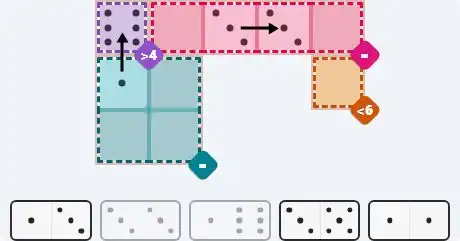
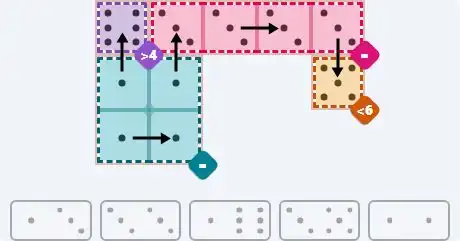
The four equals cells all show 3-pip. Domino [3–3] sits horizontally in the middle of the top row. Domino [1–3] runs vertically — 3 at the top, 1 dropping into the 2×2 block. Domino [3–5] runs vertically in the far-right column — 3 on top satisfying the equals chain, 5 below satisfying 'less than 6'. The top-left 'greater than 4' corner takes the 6-end of [1–6] placed vertically, with its 1-end dropping into the block below. Domino [1–1] sits horizontally in the bottom two cells of the 2×2 block — all four block cells show 1.
💡 One cell is already solved
A single cell sits in its own sum region. No cross-referencing, no arithmetic — reading the constraint directly tells you the pip value. That's your starting point.
💡 Follow the domino downward
That solved cell is one end of a vertical domino. The other end drops into a two-cell sum-of-6 region in the row below. With one value fixed, the adjacent cell is determined — and it feeds into another sum region right beside it.
💡 Full solution
The solo sum-of-6 cell = 6, placing [6–2] vertically: 6 above, 2 below. Sum-of-6 left pair: 6−2=4, so [2–4] is placed vertically with 2 continuing downward to the 'less than 4' slot and 4 going right. Bottom 'less than 4' pair: 2 and 0 via [0–3] (0 at bottom, 3 pointing up). Sum-of-6 lower-right: 3+3=6 via [4–3] vertical (4 above, 3 below). Sum-of-6 upper-right: 4+2=6 via [2–2] horizontal. Top equals pair: [1–1] horizontal, both cells = 1.
💡 The five-cell equals is your anchor
A five-cell equals constraint spans the center-right of the grid. Start by asking: which pip value could possibly fill all five cells at once?
💡 Two values, one valid
Count pip frequencies across your twelve dominoes. Two different values each appear exactly five times. One is ruled out immediately — two adjacent cells inside the region would require a double-pip domino that simply isn't in your set.
💡 Place the five-pip region
All five cells = 5-pip. Domino [5–5] covers the horizontal adjacent pair. Domino [5–0] covers one cell of the region plus the cell directly below (leaving a 0-pip exposed). Domino [1–5] fills the far corner (1 pointing inward, satisfying 'greater than 0'). Domino [2–5] covers the last cell (2 adjacent to 'greater than 1', satisfied).
💡 Chase the 0-pip chain outward
The 0 left by [5–0] triggers an equals pair below it, then [4–0] handles the bottom layer (0 down, 4 sideways). The bottom-right three-cell equals locks at 4-pip. Meanwhile, three separate dominoes with 0-ends — [2–0], [6–0], and [3–0] — fill the vertical three-cell equals column in the center, exposing 2, 6, and 3 outward.
💡 Full solution
Five-cell equals (all 5): [5–5] at [3,4]–[3,5]; [5–0] vertical at [4,4]–[5,4]; [1–5] reversed at [4,6]–[4,5]; [2–5] horizontal at [2,3]–[2,4]. 0-chain: [4–0] at [6,5]–[6,4] ([6,4]=0, [6,5]=4); [4–4] at [5,6]–[6,6] (bottom-right equals=4). Center column equals (all 0): [2–0] at [0,2]–[1,2]; [6–0] at [2,1]–[2,2]; [3–0] at [3,1]–[3,2]. Sum-of-10: [2,1]=6 → [2,0]=4 via [1–4] vertical ([1,0]=1). Sum-of-5: [0,2]=2, [1,0]=1 → [1–1] horizontal closes [0,0]=1, [0,1]=1 (1+1+2+1=5). Sum-of-7: [4–3] horizontal at [4,2]–[4,3].

🎨 Pips Solver

Apr 25, 2026

Click a domino to place it on the board. You can also click the board, and the correct domino will appear.

Final Answer & Complete Solution For Hard Level

The key to solving today's hard puzzle was identifying the placement for the critical dominoes highlighted in the starting grid. Once those were in place, the rest of the puzzle could be solved logically. See the final grid below to compare your solution.

Starting Position & Key First Steps

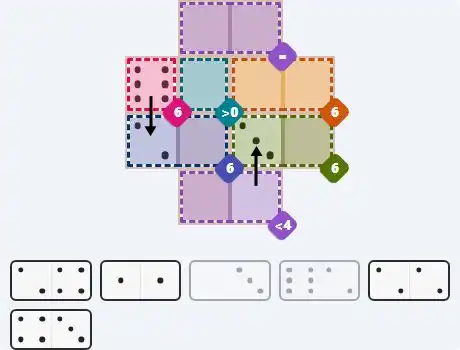
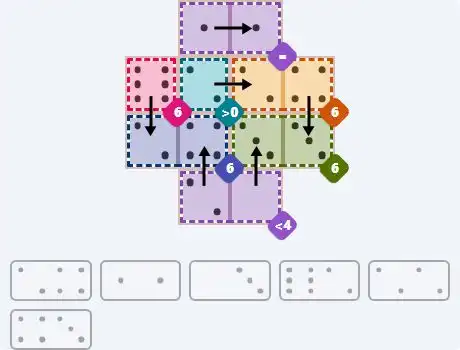
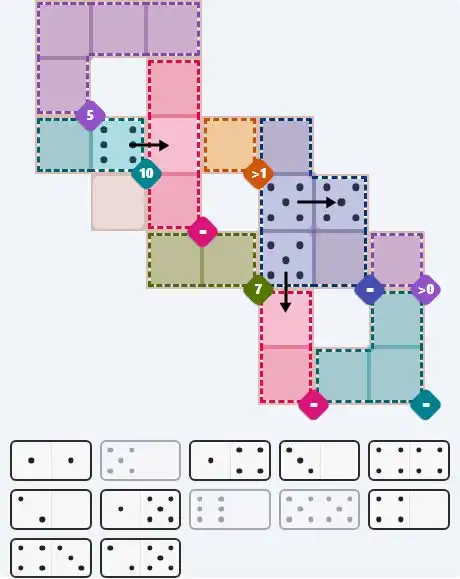
Pips hint for April 25, 2026 – hard level puzzle grid with critical first placements and strategy

This image shows the initial puzzle grid for the hard level, with a few critical first placements highlighted.

Final Answer: The Solved Grid for Hard Mode

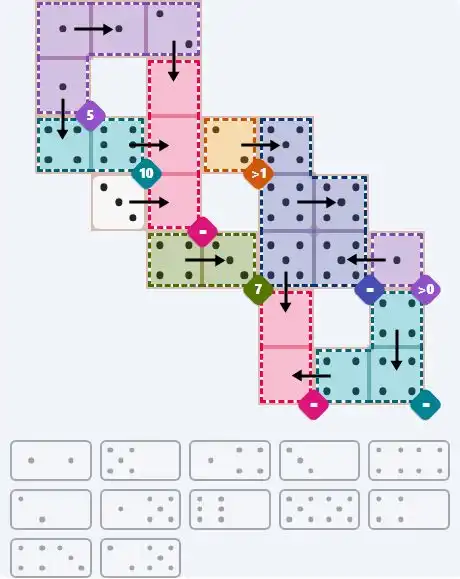
NYT Pips April 25, 2026 hard puzzle full solution grid showing final answer with hints

Compare this final grid with your own solution to see the correct placement of all dominoes.

🔧 Step-by-Step Answer Walkthrough For Easy Level

1
Step 1: Two values tie — test them both
Scanning the five dominoes, pip-1 and pip-3 each appear exactly four times. The four-cell equals region in the top row could hold either. Neither is ruled out by the constraint label itself — you need to check which one produces valid domino pairings with the neighboring constraints.
2
Step 2: Testing pip-1 for the top row fails
If the four top cells hold 1-pip, the 2×2 block below must be filled from what remains: 3,3,3,6,3,5. Four 3s could fill it, leaving 6 and 5 for the corner and far-right cell. The corner cell [0,0] (> 4) is adjacent to [1,0] which would hold 3 — requiring a [6,3] or [3,6] domino. That domino doesn't exist in the set; only [1,6] is available. Dead end: pip-1 cannot fill the top row.
3
Step 3: Pip-3 fills the top row and resolves the corner
With pip-3 in the four top cells, the remaining four 1-pips go to the 2×2 block. Two values remain unplaced: 6 and 5. The corner [0,0] connects to [1,0] (= 1 in the block), so the domino must be [1,6] oriented vertically — [0,0]=6 satisfies 'greater than 4'. The far-right cell [1,4] gets 5, satisfying 'less than 6', via [3,5] oriented vertically with the 3-end on top.
4
Step 4: Assign the remaining three dominoes
Domino [3,3] covers [0,2]–[0,3] horizontally (both = 3). Domino [1,3] covers [1,1]–[0,1] vertically: 1 at [1,1] (inside the 2×2 block), 3 at [0,1] (completing the top equals chain). Domino [1,1] covers [2,0]–[2,1] horizontally: both = 1. The full 2×2 block [1,0]=1, [1,1]=1, [2,0]=1, [2,1]=1 satisfies the equals constraint ✓.

🔧 Step-by-Step Answer Walkthrough For Medium Level

1
Step 1: The self-contained cell unlocks everything
One region contains exactly one cell and carries a sum-of-6 constraint. A single-cell sum region is already solved — the cell must equal the target. Here, [1,0] = 6. Among the six dominoes, only [6,2] carries a 6-pip. It sits vertically: 6 at [1,0], 2 at [2,0].
2
Step 2: Left column cascades downward
[2,0] = 2 from Step 1. It sits inside the two-cell sum-of-6 region [2,0],[2,1]. 6 − 2 = 4, so [2,1] = 4. Domino [2,4] covers [3,1]–[2,1] vertically: 2 at [3,1] (extending into the bottom 'less than 4' row), 4 at [2,1] ✓.
3
Step 3: Bottom constraint resolves
The 'less than 4' region covers [3,1] and [3,2]. [3,1] = 2 (< 4 ✓) from Step 2. Domino [0,3] handles [3,2]–[2,2] vertically: 0 at [3,2] (< 4 ✓), 3 at [2,2].
4
Step 4: Sum-of-6 pairs close the right side
Lower-right sum pair [2,2],[2,3]: [2,2] = 3, so [2,3] = 3 (6−3=3). Domino [4,3] covers [1,3]–[2,3] vertically: 4 at [1,3], 3 at [2,3]. Upper-right sum pair [1,2],[1,3]: [1,3] = 4, so [1,2] = 2 (6−4=2). Domino [2,2] covers [1,1]–[1,2] horizontally: [1,1]=2, [1,2]=2. The 'greater than 0' constraint on [1,1] = 2 ✓.
5
Step 5: Top equals closes the grid
Domino [1,1] is the only one left. It covers [0,1]–[0,2] horizontally: both = 1. The equals constraint on [0,1],[0,2] is satisfied ✓. All six dominoes placed.

🔧 Step-by-Step Answer Walkthrough For Hard Level

1
Step 1: Identify the five-cell anchor
Count each pip value's frequency across all twelve dominoes. Pip-0 appears five times: in [5,0],[3,0],[2,0],[6,0],[4,0]. Pip-5 also appears five times: in [5,0],[1,5],[5,5],[2,5]. Both could theoretically fill the five-cell equals region. Two of the region's cells are horizontally adjacent — they must form one domino. You have [5,5] (double-five) but no [0,0] (double-zero). So pip-0 is impossible for the equals region; all five cells = 5.
2
Step 2: Place the five five-pip dominoes
Domino [5,5] covers [3,4]–[3,5] horizontally: both = 5. Domino [5,0] covers [4,4]–[5,4] vertically: [4,4]=5, [5,4]=0. Domino [1,5] covers [4,6]–[4,5]: [4,6]=1 (satisfying 'greater than 0' ✓), [4,5]=5. Domino [2,5] covers [2,3]–[2,4] horizontally: [2,3]=2 (satisfying 'greater than 1' ✓), [2,4]=5.
3
Step 3: Chase the 0-pip chain
[5,4]=0 from Step 2. The two-cell equals [5,4],[6,4] forces [6,4]=0. Domino [4,0] covers [6,5]–[6,4] horizontally: [6,5]=4, [6,4]=0. The three-cell equals [5,6],[6,5],[6,6]: [6,5]=4 forces all three to 4. Domino [4,4] covers [5,6]–[6,6] vertically: [5,6]=4, [6,6]=4 ✓.
4
Step 4: Fill the center-column three-cell equals
The equals constraint links [1,2],[2,2],[3,2]. Three separate dominoes each contribute a 0-end into that column. Domino [2,0] covers [0,2]–[1,2] vertically: [0,2]=2, [1,2]=0. Domino [6,0] covers [2,1]–[2,2] horizontally: [2,1]=6, [2,2]=0. Domino [3,0] covers [3,1]–[3,2] horizontally: [3,1]=3 (empty constraint, no restriction), [3,2]=0. All three column cells = 0 ✓.
5
Step 5: Close the top-left from sum-of-10 inward
[2,1]=6 (from Step 4). Sum-of-10 pair [2,0],[2,1]: [2,0] = 10−6 = 4. Domino [1,4] covers [1,0]–[2,0] vertically: [1,0]=1, [2,0]=4. Sum-of-5 region [0,0],[0,1],[0,2],[1,0]: [0,2]=2, [1,0]=1 already placed, so [0,0]+[0,1] = 5−2−1 = 2. Domino [1,1] covers [0,0]–[0,1] horizontally: [0,0]=1, [0,1]=1 (1+1+2+1=5 ✓). Sum-of-7: domino [4,3] covers [4,2]–[4,3] horizontally: [4,2]=4, [4,3]=3 (4+3=7 ✓). All twelve dominoes placed.
💡 Pro Tips for Similar Puzzles

Start with Constraints
Always begin with the most constrained regions - sum regions with small numbers or tight spaces.
Use Equal Regions
Use "equal" regions as anchors - they eliminate many possibilities quickly.
Work Systematically
Let the rules guide your placement rather than guessing randomly.
Double-Check
Verify each region's rules are satisfied before moving to the next.

🎓 Keep Learning & Improve