NYT Pips Hints & Answers for October 17, 2026

Oct 17, 2026

🚨 SPOILER WARNING

This page contains the final answer and the complete solution to today's NYT Pips puzzle. If you haven't attempted the puzzle yet and want to try solving it yourself first, now's your chance!

Click here to play today's official NYT Pips game first.

Want hints instead? Scroll down for progressive clues that won't spoil the fun.

SEE ALSO:

🎲 Today's Puzzle Overview

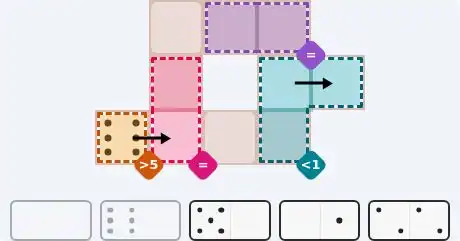
Start with today's NYT Pips easy and the board more or less introduces itself. Ian Livengood has planted a lone orange cell that wants a pip above 5 and a three-cell teal block where every pip must fall below 1 — two regions that announce their contents before you have placed a single domino. The pink equals pair then simply inherits a value from the tile that fills the orange corner, and the purple equals pair along the top finishes the job with a double. It is a warm-up of about two minutes, and nothing in it ever asks you to guess.

The medium grid is a balancing act in three bands, and you feel it the moment you set a tile down. Ian Livengood hands you two sum-2 singles that are trivially decided, but the real work happens in the middle: an equals pair on the left pressed right up against a sum-8 pair on the right, with a double sitting exactly on the seam between them. Once that seam is locked, the top row resolves from the outside in — a less-5 pair above and a greater-8 pair beside it — and the bottom row falls in two clean dominoes. Expect a false start or two if you try the corners first.

Rodolfo Kurchan's hard board is a 28-cell machine with three doubles in the tray and no obvious entry point. The trick is to follow the arithmetic that admits only one answer: two sum-0 cells, one purple and one blue, that can each take just a single pip, plus a purple equals run of three along the right edge that needs a double and one matching single from elsewhere in the tray. From there the bottom-right corner cascades — the pink sum-10 block, the teal equals pair beneath it — and only later does the top-left corner reveal how its three tiles interlock. Expect to re-read the tray more than once.

💡 Progressive Hints

Try these hints one at a time. Each hint becomes more specific to help you solve it yourself!

💡 Start with the loudest constraints
Look for the constraint types that leave no wiggle room: a 'greater than' cell and a 'less than' block each admit almost nothing, while the two equals pairs only accept matching pips. The two uncoloured free squares are your leftovers — save them for last.
💡 The orange corner and the teal block
The orange greater 5 cell in the bottom-left, sitting immediately left of the pink equals pair, has exactly one legal pip in the whole tray. The teal less 1 block on the right is just as tight — all three of its cells must take the smallest pip there is. Settle those two regions and the pink equals pair becomes a free gift: its lower cell is already decided by the tile that fills the orange corner, so its upper cell has to match it.
💡 The complete layout
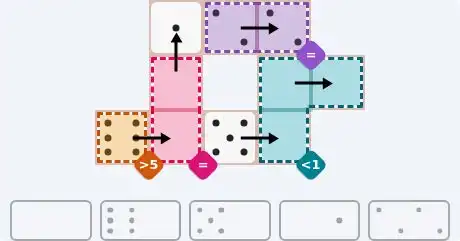
Five tiles finish the board. Lay the 0/0 double flat along the top of the teal less 1 block on the right — 0 on the left, 0 on the right. The 5/0 tile goes flat in the bottom row: 5 in the uncoloured square at the bottom centre, 0 in the teal cell tucked beneath the block's left end. Now the bottom-left: the 6/0 tile runs flat with 6 in the orange greater 5 corner and 0 in the pink equals pair's lower cell, and the 0/1 tile stands upright directly above that lower cell — 1 as the upper half in the top-left uncoloured square, 0 as the lower half in the pink pair's upper cell, so both pink cells read 0. Finish by laying the 2/2 double flat across the purple equals pair along the top edge: 2 and 2.
💡 Read the constraint types first
Two single cells are labelled sum 2, one single is a less 4, and there are two equals pairs that each demand matching pips. Those four regions collapse fastest — everything else on the board is a pair with an arithmetic target plus a pair of free squares.
💡 Work the middle band outward
The orange equals pair on the left and the blue sum 8 pair on the right share a border in the middle row, and the 5/5 double is the tile that straddles them — 5 in orange's right cell, 5 in blue's left cell. That forces a 5 into orange's left cell with a 0 above it in the uncoloured square, and leaves the blue pair needing a 3 in its right cell to reach 8.
💡 The complete layout
The 5/5 double lies flat across the middle row, 5 in the orange equals pair's right cell and 5 in the blue sum 8 pair's left cell. The 5/0 tile stands upright at orange's left end — 5 as the lower half in the orange pair's left cell, 0 as the upper half in the uncoloured square. The 3/3 double stands upright on the right, 3 as the upper half in the pink greater 8 pair's lower cell and 3 as the lower half in the blue pair's right cell, so blue reads 5+3. Along the top the 4/6 tile lies flat: 4 in the purple less 5 pair's upper cell, 6 in the pink greater 8 pair's upper cell, and the 2/0 tile slides in underneath with 2 in the teal sum 2 cell and 0 in the purple pair's lower cell. Bottom row: the 3/6 tile lies flat with 3 in the green less 4 corner and 6 in the left cell of the bottom purple equals pair, then the 6/2 tile delivers 6 to that pair's right cell and 2 to the pink sum 2 corner.
💡 Find the cells that admit one value
Two single cells — a purple sum 0 near the top and a blue sum 0 on the left edge — allow exactly one pip each. Add a purple equals run of three along the right edge that demands identical pips, and you have the three regions that decide the opening.
💡 Count what the equals regions need
The purple equals run along the right edge needs three of the same pip, which means a double plus one matching single from the tray. The teal equals pair at the very bottom-right is only a pair, so it wants a double too. Between them sits the pink sum 10 block of three cells — directly above the teal pair and immediately below the purple run.
💡 The bottom-right corner cascades
The teal equals pair takes the 0/0 double, 0 as the upper half and 0 as the lower half. The purple run takes the 6/6 double lying flat across its middle and right cells, while the 6/3 tile stands upright at the run's left end: 6 as the upper half in the run's left cell, 3 as the lower half in the top-left cell of the pink sum 10 block. The 4/3 tile then lies flat along the bottom of that block, 4 on the left and 3 on the right, giving 3+4+3.
💡 The left edge and the top-left corner
The 0/5 tile stands upright on the left edge: 5 as the upper half in the pink sum 5 cell and 0 as the lower half in the blue sum 0 cell beneath it. One row below and to the right, the 6/5 tile lies flat — 6 in the uncoloured square, 5 in the green sum 5 cell. In the top-left corner the 1/6 tile lies flat with 6 in the top cell of the purple sum 8 pair and 1 in the left cell of the pink sum 4 pair; the 2/2 double stands upright beneath it, 2 in the purple pair's lower cell and 2 in the uncoloured square below that, and the 3/5 tile stands upright one column further right, 3 in the pink sum 4 pair's right cell and 5 in the blue sum 5 cell.
💡 The complete layout
Top-left: the 1/6 tile lies flat — 6 in the purple sum 8 pair's top cell, 1 in the pink sum 4 pair's left cell; the 2/2 double stands upright below, 2 in the purple pair's lower cell and 2 in the uncoloured square; the 3/5 tile stands upright beside it, 3 in the pink pair's right cell and 5 in the blue sum 5 cell. The teal unequal column reads 6/2/3: the 2/6 tile stands vertically, 6 as the upper half in the column's top cell and 2 as the lower half in the middle cell, while the 0/3 tile lies flat at the bottom of the column — 3 as the left half in the column's lowest cell, 0 as the right half in the purple sum 0 cell. The orange sum 2 pair in the top-right takes the 2/0 tile flat, 2 left and 0 right. Centre: the 1/4 tile stands upright in the orange sum 5 pair, 1 as the upper half and 4 as the lower half. The 3/2 tile stands upright between the green sum 3 cell and the teal greater 1 cell, 3 above and 2 below. Left edge: the 0/5 tile stands upright, 5 as the upper half in the pink sum 5 cell and 0 as the lower half in the blue sum 0 cell, with the 6/5 tile lying flat below it — 6 in the uncoloured square, 5 in the green sum 5 cell. Bottom-right: the 6/3 tile stands vertically with 6 in the purple equals run's left cell and 3 in the pink sum 10 block's top-left cell, the 6/6 double lies flat across the run's middle and right cells, the 4/3 tile lies flat along the block's bottom with 4 left and 3 right, and the 0/0 double stands upright in the teal equals pair beneath.

🎨 Pips Solver

Oct 17, 2026

Click a domino to place it on the board. You can also click the board, and the correct domino will appear.

✅ Final Answer & Complete Solution For Hard Level

The key to solving today's hard puzzle was identifying the placement for the critical dominoes highlighted in the starting grid. Once those were in place, the rest of the puzzle could be solved logically. See the final grid below to compare your solution.

Starting Position & Key First Steps

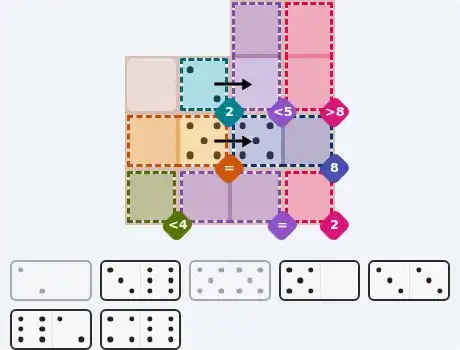
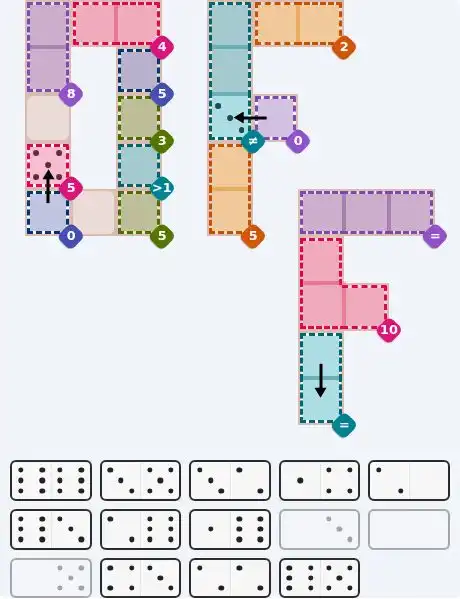
Pips hint for October 17, 2026 – hard level puzzle grid with critical first placements and strategy

This image shows the initial puzzle grid for the hard level, with a few critical first placements highlighted.

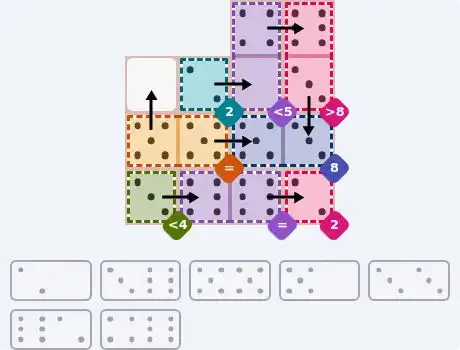
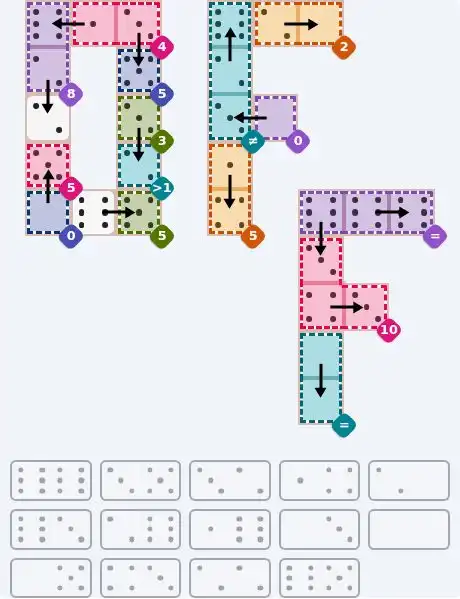
Final Answer: The Solved Grid for Hard Mode

NYT Pips October 17, 2026 hard puzzle full solution grid showing final answer with hints

Compare this final grid with your own solution to see the correct placement of all dominoes.

🔧 Step-by-Step Answer Walkthrough For Easy Level

1
Step 1: The orange cell names itself
The orange greater 5 region is a single cell in the bottom-left, wedged immediately left of the pink equals pair, and it must hold a pip above 5. Only the 6/0 tile carries a 6, so it has to lie flat right there: 6 as the left half in the orange cell, 0 as the right half next door in the pink equals pair's lower cell.
2
Step 2: The teal block is three of a kind
The teal less 1 region on the right has three cells and every one of them must sit below 1, so all three read the same tiny pip. The 0/0 double lies flat across its top row — 0 on the left, 0 on the right — and the 5/0 tile supplies the third: 0 as the right half in the cell tucked under the block's left end, 5 as the left half in the uncoloured square at the bottom centre.
3
Step 3: Pink inherits its second zero
The pink equals pair's lower cell already holds 0 from the 6/0 tile, so its upper cell must be 0 as well. The only remaining tile that carries a spare 0 alongside a 1 is the 0/1, and it stands upright: 1 as the upper half in the top-left uncoloured square, 0 as the lower half in the pink pair's upper cell.
4
Step 4: The purple pair takes the last double
Only the 2/2 double is left, and the purple equals pair along the top edge needs two matching pips, so it lies flat across both of its cells: 2 on the left, 2 on the right. Final board: teal reads 0/0/0, orange 6, pink 0/0, the free squares hold 1 and 5, and the purple pair shows 2 and 2.

🔧 Step-by-Step Answer Walkthrough For Medium Level

1
Step 1: Two single cells that simply say 2
The teal sum 2 cell in the middle-left and the pink sum 2 cell in the bottom-right corner are one-cell regions, so their pip is their sum: both will read 2. Which tile supplies each becomes obvious once the pairs around them are settled.
2
Step 2: The seam in the middle row
The orange equals pair on the left and the blue sum 8 pair on the right touch at the centre of the board, and the 5/5 double lands exactly on that boundary: 5 as the left half in the orange pair's right cell, 5 as the right half in the blue pair's left cell. Orange now has to match, so the 5/0 tile stands upright at its left end — 5 as the lower half in the orange pair's left cell, 0 as the upper half in the uncoloured free square. The blue pair's right cell now needs a 3 to reach 8.
3
Step 3: The right-hand double closes the right side
The 3/3 double stands upright on the right, straddling the blue pair and the pink greater 8 pair: 3 as the upper half in the pink pair's lower cell, 3 as the lower half in the blue pair's right cell. Blue now totals 5+3, and the pink greater 8 pair is left waiting for one large pip in its upper cell.
4
Step 4: The top rows resolve
The 4/6 tile lies flat across the top, bridging the purple less 5 pair and the pink greater 8 pair: 4 as the left half in the purple pair's upper cell, 6 as the right half in the pink pair's upper cell, which takes pink past 8. Then the 2/0 tile slides in underneath: 2 as the left half in the teal sum 2 cell, 0 as the right half in the purple pair's lower cell, so the purple pair reads 4+0 — comfortably under 5.
5
Step 5: The bottom row finishes it
The 3/6 tile lies flat along the bottom: 3 as the left half in the green less 4 corner cell, 6 as the right half in the left cell of the bottom purple equals pair. The 6/2 tile then completes that pair and the pink sum 2 corner at once — 6 as the left half in the purple pair's right cell, 2 as the right half in the pink sum 2 cell. Full board: uncoloured 0, teal 2, purple 4/0, pink 6/3 on top; orange 5/5 and blue 5/3 in the middle; green 3, purple 6/6 and pink 2 across the bottom.

🔧 Step-by-Step Answer Walkthrough For Hard Level

1
Step 1: Two cells that can only be zero
The purple sum 0 cell near the top and the blue sum 0 cell on the left edge are single-cell regions, so each takes exactly one pip, and only 0 fits. Notice too that the pink sum 5 cell sits directly above the blue sum 0 cell, which means one upright tile can serve both.
2
Step 2: The left edge fills in
That tile is the 0/5, standing vertically: 5 as the upper half in the pink sum 5 cell, 0 as the lower half in the blue sum 0 cell. One row below and to the right of it, the 6/5 tile lies flat — 6 as the left half in the uncoloured square, 5 as the right half in the green sum 5 cell — which means the top-left corner is now the only place a 6 can still go.
3
Step 3: The bottom-right corner cascades
The purple equals run on the right edge needs three identical pips, so it takes the 6/6 double lying flat across its middle and right cells plus a matching 6 from the 6/3 tile. That tile stands vertically, 6 as the upper half in the run's left cell and 3 as the lower half in the top-left cell of the pink sum 10 block. The 4/3 tile lies flat along the bottom of that block, 4 on the left and 3 on the right, so the block reads 3+4+3. Below it the teal equals pair takes the 0/0 double standing upright, 0 above and 0 below.
4
Step 4: The top-left corner locks
The 1/6 tile lies flat along the very top: 6 as the left half in the top cell of the purple sum 8 pair, 1 as the right half in the left cell of the pink sum 4 pair. The 2/2 double stands upright beneath the 6, 2 as the upper half in the purple pair's lower cell and 2 as the lower half in the uncoloured square below, completing the sum of 8. The 3/5 tile then stands upright one column further right: 3 as the upper half in the pink sum 4 pair's right cell, making 1+3, and 5 as the lower half in the blue sum 5 cell.
5
Step 5: The teal column and the centre
The teal unequal column needs three different pips. The 2/6 tile stands vertically with 6 as the upper half in the column's top cell and 2 as the lower half in the middle cell, and the 0/3 tile lies flat with 3 as the left half in the column's lowest cell and 0 as the right half in the purple sum 0 cell — 6, 2 and 3, all different. To its right the 2/0 tile lies flat across the orange sum 2 pair, 2 left and 0 right. In the centre the 1/4 tile stands upright in the orange sum 5 pair, 1 upper and 4 lower, while the 3/2 tile stands upright between the green sum 3 cell and the teal greater 1 cell, 3 above and 2 below.
6
Step 6: The completed board
Every tile is now placed: 1/6 and 2/2 and 3/5 stack through the top-left corner (purple 6/2, pink 1/3, blue 5, the 6/5 flat beside the uncoloured square); 2/6, 0/3 give the teal column 6/2/3; 2/0 fills the orange sum 2 pair; 0/5 serves pink 5 and blue 0 on the left edge; 1/4 fills the orange sum 5 pair; 3/2 links green 3 to teal's greater-1 cell; and the bottom-right runs 6/3, 6/6, 4/3 and 0/0 to complete the purple equals run of three 6s, the pink sum 10 block of 3+4+3 and the teal equals pair of 0s.
💡 Pro Tips for Similar Puzzles

Start with Constraints
Always begin with the most constrained regions - sum regions with small numbers or tight spaces.
Use Equal Regions
Use "equal" regions as anchors - they eliminate many possibilities quickly.
Work Systematically
Let the rules guide your placement rather than guessing randomly.
Double-Check
Verify each region's rules are satisfied before moving to the next.

🎓 Keep Learning & Improve