NYT Pips Hints & Answers for July 21, 2026

Jul 21, 2026

🚨 SPOILER WARNING

This page contains the final **answer** and the complete **solution** to today's NYT Pips puzzle. If you haven't attempted the puzzle yet and want to try solving it yourself first, now's your chance!

Click here to play today's official NYT Pips game first.

Want hints instead? Scroll down for progressive clues that won't spoil the fun.

SEE ALSO:

🎲 Today's Puzzle Overview

In today's NYT Pips easy puzzle, Ian Livengood hands you a compact grid where the central constraint practically shouts the first move. You'll spot a three-cell region demanding a sum of 10, and since the pip ceiling is 6, the only workable trio is two 2s and a 6. Once you slot those in, a neat row of equals and sum pairs cascades, and the puzzle resolves in a few satisfying clicks. It's a gentle warm-up that rewards pattern recognition over brute force.

Stepping up to medium, Livengood stretches the grid and sprinkles in a lonely single-cell sum-2 that acts like a key in a lock. That tiny hint forces a specific domino, which unlocks the sum-8 column, then triggers a chain of equalities that sweep across the board. A sprawling four-cell equals region in the lower right becomes your compass, and you'll find each placement snapping into place with a logical rhythm. The puzzle feels like a well-orchestrated domino tumble.

Rodolfo Kurchan's hard puzzle strips everything down to bare arithmetic: almost every cell is its own sum mandate, with values ranging from 0 to 5. You'll begin by collecting every cell that screams zero, and then pair them with neighboring single-digit sums. The scarcity of multi-cell regions means you must hold the domino adjacency logic in your head while juggling a few equals couplets. It's an intense but elegant solve that tests your ability to track pip counts and forced placements simultaneously.

💡 Progressive Hints

Try these hints one at a time. Each hint becomes more specific to help you solve it yourself!

💡 Hint 1: Spot the Tight Sum
Start by scanning the regions; look for a multi-cell sum constraint that forces a very limited set of pip values.
💡 Hint 2: Target the Top Trio
The top row's three-cell region demands a sum of 10. Only two 2s and a 6 can make it work here. After that, the equals region on the left of row 1 will snap into place.
💡 Hint 3: Full Solution
The sum-10 trio in [0,0],[0,1],[0,2] resolves with domino [2,2] on [0,0][0,1] (both 2) and domino [6,4] on [0,2][0,3] (6 and 4). Row 1's equals region [1,0][1,1] gets domino [1,3] — 3 goes to [1,0], the 1 to less-2 cell [2,0]. Domino [5,3] then provides 3 for [1,1] and 5 for [1,2]. Finally, domino [2,5] covers the sum-10 pair [1,2][1,3] with 5 in [1,3] and the 2 lands in sum-2 cell [2,3].
💡 Hint 1: Find the Tiny Teaser
Seek out the tiniest constraint — a lone cell that can only hold one pip. It will trigger a domino chain.
💡 Hint 2: The Keystone Cell
The single-cell sum-2 at [1,1] pins that cell to 2. It must pair with [1,0], which forces [1,0] to be 4 to satisfy the column sum-8. That opens up the top row.
💡 Hint 3: Full Solution
[1,1]=2 forces domino [2,4] (pips 2,4) there, giving [1,0]=4. The sum-8 column then requires [0,0]=4, so domino [6,4] covers [0,1]=6 and [0,0]=4, satisfying the equals pair [0,1][0,2] both 6. Domino [5,6] fills [1,2]=5, [0,2]=6. The equals region [1,2][1,3] dictates [1,3]=5, so domino [2,5] goes to [1,4]=2 and [1,3]=5. The long equals chain [1,4][2,4][3,3][3,4] all must be 2: [2,4] already 2, so domino [2,3] places [2,4]=2 and [2,3]=3 (meeting sum-3 at [2,3]), domino [2,2] fills [3,3][3,4] both 2. The equals trio [1,5][1,6][2,6] all 0 is satisfied by domino [0,0] on [1,5][1,6] both 0 and domino [1,0] with 0 at [2,6] and 1 at [3,6] (less-2).
💡 Hint 1: Zero In on Zeros
This puzzle is dominated by single-cell sum regions. Start by identifying cells that can only be zero — they'll anchor the entire grid.
💡 Hint 2: Map the Five Zeros
The five cells with sum 0 ([2,0], [2,2], [3,3], [5,3], [7,0]) must get a pip of 0. Each one forces a specific domino placement because they must pair with a neighboring cell — the adjacency clues are tight.
💡 Hint 3: Tackle the Ones
With the 0-cells pinned, look at the low single-cell sums like 1 and 2. For instance, [2,1] sum 1 forces that cell to 1, and the adjacent [2,3] sum 1 forces 1 there. The dominoes [0,1] and [0,2] will cover these. The equals region [1,0][1,1] will start to align.
💡 Hint 4: Untangle the Equals
Now untangle the equals regions. The vertical equals pair [3,1][4,1] both need the same value, and the triple equals [6,2][7,1][7,2] must match. These couple with the single-cell sums to resolve the remaining dominoes — use pips 3 and 5 to fill out.
💡 Hint 5: Full Solution
Full solution: Place domino [0,1] with 0 at [3,3] and 1 at [2,3]. Domino [0,2] covers [2,0]=0 and [3,0]=2. Domino [0,3] on [7,0]=0 and [7,1]=3. Domino [0,4] gives [2,2]=0 and [1,2]=4. Domino [0,5] goes to [5,3]=0 and [6,3]=5. Domino [1,2] fills [2,1]=1 and [1,1]=2 (equals [1,0]). Domino [1,3] with 1 at [3,2] and 3 at [3,1] (then equals with [4,1]=3 via domino [3,4] on [4,1]=3,[4,0]=4). Domino [1,4] places 1 at [4,2] and 4 at [4,3]. Domino [1,5] gives 1 at [5,1] and 5 at [6,1]. Domino [2,3] fills [1,0]=2 and [0,0]=3. Domino [2,4] with 2 at [0,3] and 4 at [1,3]. Domino [2,5] on [5,0]=2 and [6,0]=5. Domino [3,4] on [4,1]=3 and [4,0]=4. Domino [3,5] on [7,2]=3 and [7,3]=5. Domino [4,5] covers [0,1]=4 and [0,2]=5. Domino [3,6] with 3 at [6,2] and 6 at [5,2].

🎨 Pips Solver

Jul 21, 2026

Click a domino to place it on the board. You can also click the board, and the correct domino will appear.
Final Answer & Complete Solution For Hard Level

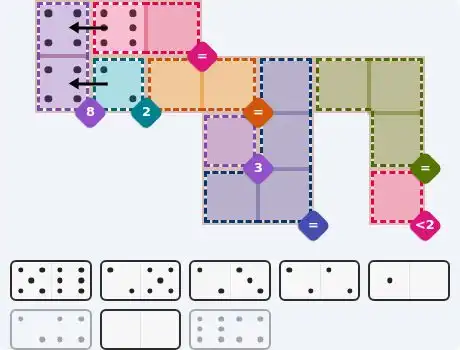
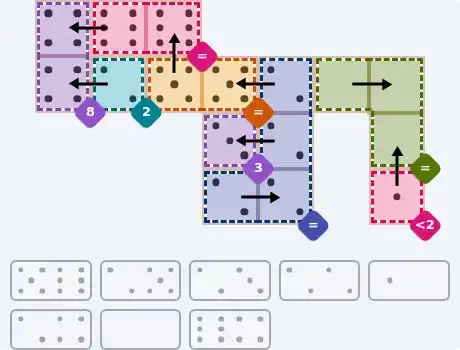
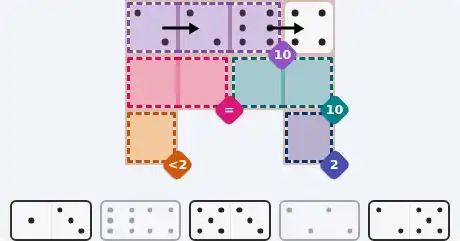
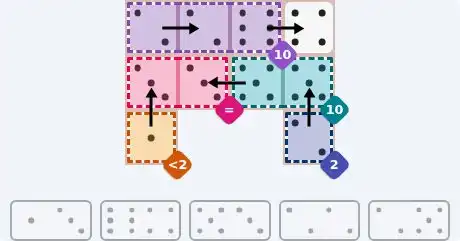
The key to solving today's hard puzzle was identifying the placement for the critical dominoes highlighted in the starting grid. Once those were in place, the rest of the puzzle could be solved logically. See the final grid below to compare your solution.

Starting Position & Key First Steps
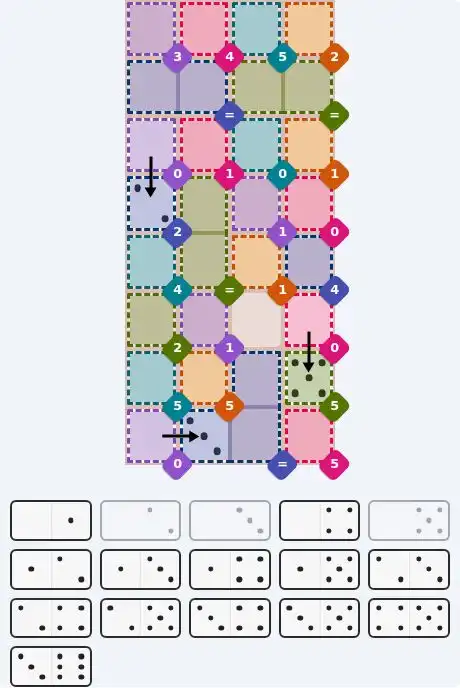
Pips hint for July 21, 2026 – hard level puzzle grid with critical first placements and strategy

This image shows the initial puzzle grid for the hard level, with a few critical first placements highlighted.

Final Answer: The Solved Grid for Hard Mode
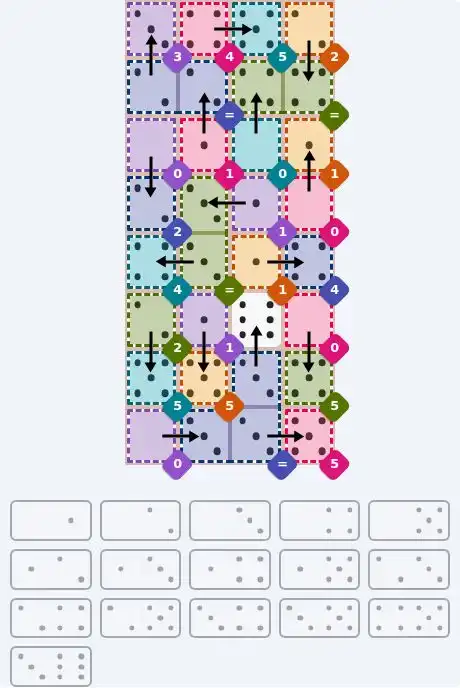
NYT Pips July 21, 2026 hard puzzle full solution grid showing final answer with hints

Compare this final grid with your own solution to see the correct placement of all dominoes.

🔧 Step-by-Step Answer Walkthrough For Easy Level

1
Step 1: Unpack the Sum-10 Region
The three cells [0,0], [0,1], [0,2] must sum to 10. The pool of dominoes includes [2,2] and [6,4]. Placing [2,2] on [0,0] and [0,1] gives both cells 2. Then [0,2] must be 6, so the [6,4] domino must place its 6 on [0,2], leaving 4 to fall in the unconstrained [0,3].
2
Step 2: Satisfy the Less-2 Cell
The cell [2,0] has a less-than-2 constraint, so it must be 0 or 1. The only unused domino that can give a low pip here is [1,3]. Place it with 1 in [2,0] and the 3 in [1,0].
3
Step 3: Fill the Equals Pair
The equals region [1,0] and [1,1] forces [1,1]=3. That value must come from the domino [5,3]; put 3 in [1,1] and its 5 in [1,2].
4
Step 4: Wrap Up the Last Sum
The sum-10 pair [1,2] and [1,3] needs 5+5. The domino [2,5] provides the second 5 for [1,3] and drops its 2 into the sum-2 cell [2,3].

🔧 Step-by-Step Answer Walkthrough For Medium Level

1
Step 1: The Solitary Sum-2
Cell [1,1] is a sum-2 region — it must be exactly 2. This cell is adjacent only to [1,0] within the grid, so the domino covering them must contain a 2. The domino [2,4] (pips 2 and 4) fits perfectly: put 2 on [1,1] and 4 on [1,0].
2
Step 2: Column Sum-8 Unlocks Top
With [1,0]=4, the sum-8 region [0,0]+[1,0]=8 forces [0,0]=4. The domino [6,4] must be used: 4 on [0,0], 6 on [0,1]. The equals region [0,1][0,2] then demands [0,2]=6, so place domino [5,6] with 6 on [0,2] and 5 on [1,2].
3
Step 3: Extend the Equals
The equals region [1,2][1,3] now requires [1,3]=5. That 5 comes from domino [2,5] placed with 5 at [1,3] and 2 at [1,4].
4
Step 4: The Four-Cell Equals Chain
The chain [1,4],[2,4],[3,3],[3,4] must be equal; [1,4]=2 so all are 2. The domino [2,3] covers [2,4]=2 and [2,3]=3 (satisfying the sum-3 cell [2,3]). The domino [2,2] then cleanly fills [3,3] and [3,4] both 2.
5
Step 5: Zero Trio and Finish
The equals region [1,5],[1,6],[2,6] must all be 0. Use domino [0,0] on [1,5] and [1,6] (both 0), and domino [1,0] on [2,6]=0 with the 1 going to [3,6] — which fits the less-2 constraint there perfectly.

🔧 Step-by-Step Answer Walkthrough For Hard Level

1
Step 1: Anchor the Zeroes
Five cells demand a sum of 0: [2,0], [2,2], [3,3], [5,3], [7,0]. All must be 0. Their forced adjacencies determine dominoes: [2,0] only touches [3,0] → use [0,2] (0 at [2,0], 2 at [3,0]); [7,0] only touches [7,1] → [0,3] (0 at [7,0], 3 at [7,1]); [5,3] touches [6,3] (sum 5) → [0,5] (0 at [5,3], 5 at [6,3]); [2,2] touches [1,2] → [0,4] (0 at [2,2], 4 at [1,2]); [3,3] touches [2,3] (sum 1) → [0,1] (0 at [3,3], 1 at [2,3]).
2
Step 2: Fill Sum-1 and Sum-2 Neighbors
[2,1]=1, its only available neighbor is [1,1] → domino [1,2] (1,2) goes [2,1]=1 and [1,1]=2. The equals pair [1,0][1,1] forces [1,0]=2 → domino [2,3] (2,3) places 2 at [1,0] and 3 at [0,0] (satisfying sum 3). [3,2]=1, neighbor [3,1] → domino [1,3] (1,3) places 1 at [3,2] and 3 at [3,1]. The equals region [3,1][4,1] makes [4,1]=3; domino [3,4] (3,4) fills [4,1]=3 and [4,0]=4 (sum 4).
3
Step 3: Continue Sum-1 Cells
[4,2]=1 → domino [1,4] (1,4) placed [4,2]=1 and [4,3]=4 (sum 4). [5,1]=1 → domino [1,5] (1,5) placed [5,1]=1 and [6,1]=5 (sum 5). [5,0]=2 → domino [2,5] (2,5) placed [5,0]=2 and [6,0]=5.
4
Step 4: Top Row Singles
Top row remaining: [0,1] sum 4, [0,2] sum 5, [0,3] sum 2. With [0,0]=3, use domino [4,5] (4,5) on [0,1]=4 and [0,2]=5. Then domino [2,4] (2,4) on [0,3]=2 and [1,3]=4, matching the equals region [1,2][1,3] both 4.
5
Step 5: Resolve Triple Equals
The equals region [6,2],[7,1],[7,2] all must match. [7,1] is already 3, so [6,2] and [7,2] need 3. Domino [3,5] (3,5) goes to [7,2]=3 and [7,3]=5 (sum 5). Domino [3,6] (3,6) goes to [6,2]=3 and the empty [5,2]=6.

💡 Pro Tips for Similar Puzzles

Start with Constraints
Always begin with the most constrained regions - sum regions with small numbers or tight spaces.
Use Equal Regions
Use "equal" regions as anchors - they eliminate many possibilities quickly.
Work Systematically
Let the rules guide your placement rather than guessing randomly.
Double-Check
Verify each region's rules are satisfied before moving to the next.

🎓 Keep Learning & Improve