NYT Pips Hints & Answers for August 7, 2026

Aug 7, 2026

๐Ÿšจ SPOILER WARNING

This page contains the final **answer** and the complete **solution** to today's NYT Pips puzzle. If you haven't attempted the puzzle yet and want to try solving it yourself first, now's your chance!

Click here to play today's official NYT Pips game first.

Want hints instead? Scroll down for progressive clues that won't spoil the fun.

SEE ALSO:

๐ŸŽฒ Today's Puzzle Overview

Today's NYT Pips easy, from Ian Livengood, is a perfect warm-up โ€” two single-cell sum regions give away free values, and the rest cascades without any guesswork. If you're new to Pips, this one will make you feel like a pro.

Rodolfo Kurchan's medium puzzle introduces a tidy bottleneck: an equals region that immediately locks in a value, paired with a high-sum pair that demands careful domino selection. Once you identify which dominoes feed those, the board resolves in a clean chain.

Kurchan's hard is where the heat turns up. A grid packed with single-cell sum constraints means almost every cell's value is telegraphed, but the real challenge is pairing them all correctly with the remaining blank cells. You'll need to track zeros meticulously; patience and a systematic approach are essential to avoid getting crossed up.

๐Ÿ’ก Progressive Hints

Try these hints one at a time. Each hint becomes more specific to help you solve it yourself!

๐Ÿ’ก Hint 1: Spot the forced values
Start by scanning for sum regions that leave no wiggle room โ€” a single-cell sum or a tiny two-cell sum with very limited domino options. These will give you free numbers to anchor the grid.
๐Ÿ’ก Hint 2: Zero in on the anchors
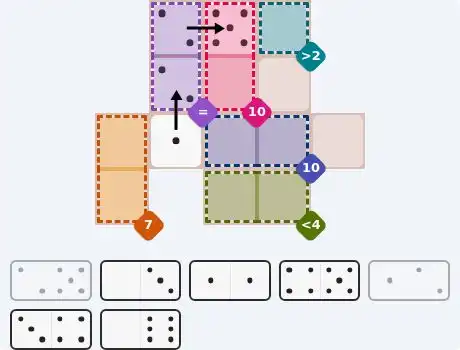
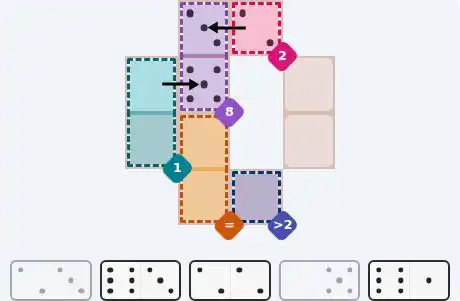
The sum-2 region in the top right forces the cell at [0,2] to be 2. That same number will pair with a 3 in the domino that covers it. Meanwhile, the sum-1 pair in the left column demands a 0 and a 1, which pulls in a specific domino with a 6 on the other end.
๐Ÿ’ก Hint 3: Full solution walkthrough
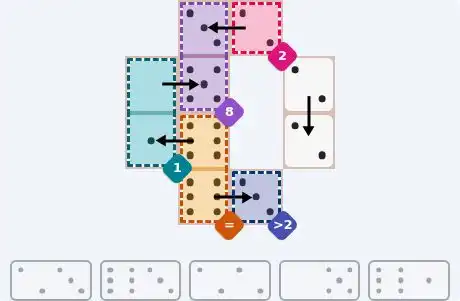
Place domino [2,3] with 2 at [0,2] and 3 at [0,1]. That satisfies the sum-2 and sets up sum-8: [0,1]=3, so [1,1] must be 5. Use domino [0,5] vertically with 0 at [1,0] and 5 at [1,1]. The sum-1 region then forces [2,0]=1; domino [6,1] goes vertically with 6 at [2,1] and 1 at [2,0]. The equals region [2,1],[3,1] forces [3,1]=6, so place domino [6,3] horizontally with 6 at [3,1] and 3 at [3,2] (satisfying greater-2). Finally, the empty region [1,3],[2,3] takes domino [2,2] vertically, both 2.
๐Ÿ’ก Hint 1: Look for equal cells and high sums
This puzzleโ€™s first foothold is an equals region โ€” two cells that must hold identical numbers. Couple that with a sum-10 pair nearby, and think about which dominoes could supply the matching digits without breaking any other rule.
๐Ÿ’ก Hint 2: Find the right dominoes for the bottleneck
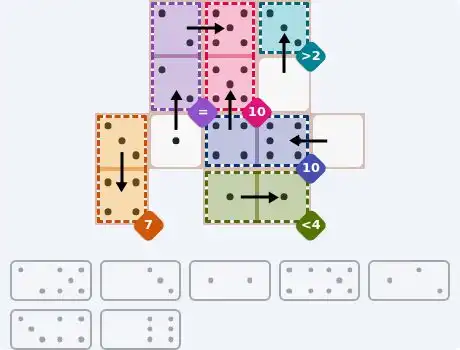
Focus on the left side: the equals region at [0,1] and [1,1] forces those cells to be 2s. The sum-10 region at [0,2] and [1,2] then needs a pair of 5s. The only way to achieve both is to place the [2,5] domino horizontally from [0,1] to [0,2], and the [1,2] domino vertically with its 2 on [1,1] and its 1 on [2,1].
๐Ÿ’ก Hint 3: Full solution
Place domino [2,5] with 2 at [0,1] and 5 at [0,2]. That gives the equals region its first 2 and the sum-10 its first 5. Place domino [1,2] with 2 at [1,1] (equals second cell) and 1 at [2,1]. Now sum-10โ€™s second cell [1,2] needs 5; use domino [4,5] vertically with 5 at [1,2] and 4 at [2,2]. The greater-2 single at [0,3] requires >2; place [0,3] domino with 3 at [0,3] and 0 at [1,3]. Sum-7 at [2,0],[3,0] takes domino [3,4] with 3 at [2,0] and 4 at [3,0]. The remaining sum-10 pair [2,2],[2,3] is part-done: [2,2]=4, so [2,3]=6; place domino [0,6] horizontally with 6 at [2,3] and 0 at [2,4]. Finally, the less-4 pair [3,2],[3,3] takes the [1,1] domino horizontally, both 1.
๐Ÿ’ก Hint 1: Let the single-cell sums talk
This grid is packed with single-cell sum constraints โ€” each alone tells you exactly what number belongs in that cell. Start by writing down all those forced values; you'll immediately have dozens of numbers locked in, especially zeros and small digits.
๐Ÿ’ก Hint 2: Focus on the zeros and ones
The sum-0 cell at [0,1] is a 0, and its neighbor [0,2] is a 2 (sum-2). The sum-1 cells at [1,1] and [1,3] are 1s, and the empty row 2 cells will become a trio of zeros to pair with the fixed numbers above them. Pay attention to which dominoes contain 0 and which contain 1.
๐Ÿ’ก Hint 3: Pair the obvious couples
The 0 at [0,1] naturally pairs with the 2 at [0,2] via the [0,2] domino. The 1 at [1,1] must pair with an adjacent 0 โ€” the empty [2,1] is the only option, forcing the [0,1] domino. Similarly, the 5 at [1,2] can only pair with a 0 in the empty [2,2] using the [0,5] domino.
๐Ÿ’ก Hint 4: Build out the middle rows
With the top three rows settled, the 2 at [0,3] pairs with the 1 at [1,3] using the [1,2] domino. The 4 at [3,0] needs a 0 from [2,0] via [0,4]. The 1 at [2,3] pairs with the 3 at [3,3] using [1,3], and so on. Work systematically: every fixed digit has only one viable domino neighbor given what's left.
๐Ÿ’ก Hint 5: Full solution
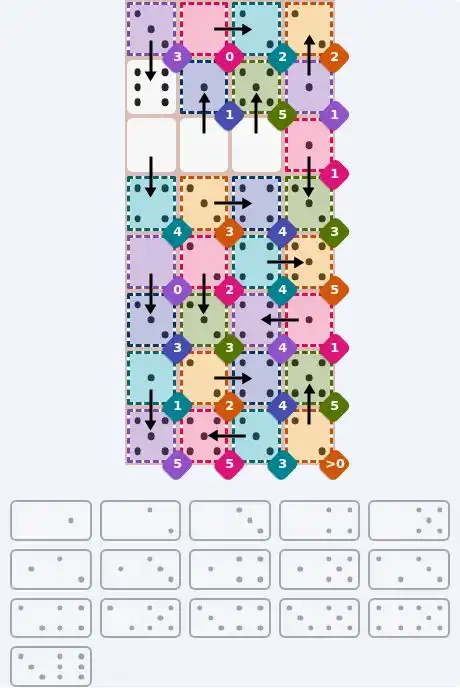
Place dominos as follows: [0,2] horizontally at [0,1]=0, [0,2]=2 (sums 0 & 2). [0,1] vertically at [2,1]=0, [1,1]=1 (sum 1 & empty). [0,5] vertically at [2,2]=0, [1,2]=5 (sum 5 & empty). [1,2] vertically at [1,3]=1, [0,3]=2 (sums 1 & 2). [0,4] vertically at [2,0]=0, [3,0]=4 (sum 4 & empty). [0,3] vertically at [4,0]=0, [5,0]=3 (sums 0 & 3). [3,4] horizontally at [3,1]=3, [3,2]=4 (sums 3 & 4). [4,5] horizontally at [4,2]=4, [4,3]=5 (sums 4 & 5). [2,3] vertically at [4,1]=2, [5,1]=3 (sums 2 & 3). [1,4] vertically at [5,3]=1, [5,2]=4 (sums 1 & 4). [2,4] horizontally at [6,1]=2, [6,2]=4 (sums 2 & 4). [1,5] vertically at [6,0]=1, [7,0]=5 (sums 1 & 5). [3,5] horizontally at [7,2]=3, [7,1]=5 (sums 3 & 5). [2,5] horizontally at [7,3]=2, [6,3]=5 (greater 0 & sum 5). [3,6] vertically at [0,0]=3, [1,0]=6 (sum 3 & empty). The three empty cells [2,0], [2,1], [2,2] all became 0s, paired as above.

๐ŸŽจ Pips Solver

Aug 7, 2026

Click a domino to place it on the board. You can also click the board, and the correct domino will appear.

โœ… Final Answer & Complete Solution For Hard Level

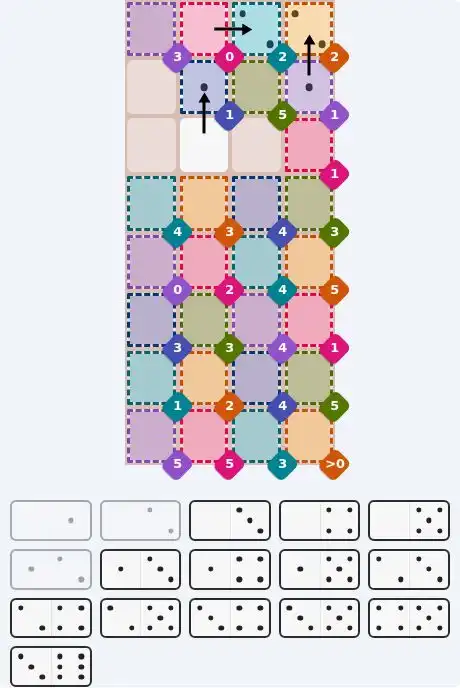
The key to solving today's hard puzzle was identifying the placement for the critical dominoes highlighted in the starting grid. Once those were in place, the rest of the puzzle could be solved logically. See the final grid below to compare your solution.

Starting Position & Key First Steps

Pips hint for August 7, 2026 โ€“ hard level puzzle grid with critical first placements and strategy

This image shows the initial puzzle grid for the hard level, with a few critical first placements highlighted.

Final Answer: The Solved Grid for Hard Mode

NYT Pips August 7, 2026 hard puzzle full solution grid showing final answer with hints

Compare this final grid with your own solution to see the correct placement of all dominoes.

๐Ÿ”ง Step-by-Step Answer Walkthrough For Easy Level

1
Step 1: The single-cell sum-2
The region at [0,2] has a sum-2 target and only one cell, so its value must be exactly 2. This is the strongest anchor in the grid and will force an immediate domino placement.
2
Step 2: Place the [2,3] domino
The 2 at [0,2] must come from a domino containing a 2. The only available is [2,3]. Its other cell must cover an adjacent neighbor; the only viable orientation puts the 3 on [0,1] (satisfying the future needs of the sum-8 region).
3
Step 3: Feed the sum-8 and sum-1
With [0,1]=3, the sum-8 region demands [1,1]=5. The domino [0,5] is the only 5-bearer; place it vertically with 5 at [1,1] and 0 at [1,0]. Then the sum-1 pair [1,0],[2,0] forces [2,0]=1.
4
Step 4: The equals chain and final fill
The equals region [2,1],[3,1] means both cells must match. We already have [2,1] as the partner of [2,0]โ€™s 1 โ€” the [6,1] domino places 6 there and 1 at [2,0]. So [3,1] must be 6; domino [6,3] fits horizontally with 6 at [3,1] and 3 at [3,2] (satisfying greater-2). The last empty pair [1,3],[2,3] takes the [2,2] domino vertically, both 2.

๐Ÿ”ง Step-by-Step Answer Walkthrough For Medium Level

1
Step 1: Exploit the equals region
Cells [0,1] and [1,1] must be identical. Scanning the available dominoes, no single tile has two equal numbers, so we need two different dominoes that each supply a matching digit. The only plausible pairing comes from a 2: one from a [2,5] domino covering [0,1] and one from a [1,2] domino hitting [1,1].
2
Step 2: Lock the first half of sum-10
Place the [2,5] domino horizontally with 2 at [0,1] and 5 at [0,2]. Now the sum-10 pair [0,2],[1,2] has a 5 on top, so [1,2] must become 5 as well.
3
Step 3: Complete the equals with [1,2]
Place the [1,2] domino vertically: its 2 lands on [1,1] (matching [0,1]โ€™s 2) and its 1 lands on [2,1], which obeys the empty constraint. This solidifies both the equals bottleneck and the empty cell.
4
Step 4: Resolve the remaining high numbers
We still need a 5 at [1,2]; the [4,5] domino placed vertically with 5 at [1,2] and 4 at [2,2] does the job. Now the greater-2 single at [0,3] comes into play: it must be >2, so [0,3] gets a 3 from the [0,3] domino, with its 0 partner dropping into [1,3].
5
Step 5: Finish the bottom sums
The sum-7 region [2,0],[3,0] takes the [3,4] domino vertically with 3 and 4. The sum-10 cell [2,3] needs a 6 to pair with [2,2]โ€™s 4; the [0,6] domino places 6 there and 0 at [2,4]. Finally, the less-4 pair [3,2],[3,3] must be below 4, so the [1,1] domino fills both with 1s horizontally.

๐Ÿ”ง Step-by-Step Answer Walkthrough For Hard Level

1
Step 1: Harvest the single-cell sums
Nearly every cell is its own region with a target sum, so write these values immediately: [0,0]=3, [0,1]=0, [0,2]=2, [0,3]=2, [1,1]=1, [1,2]=5, [1,3]=1, [2,3]=1, [3,0]=4, [3,1]=3, [3,2]=4, [3,3]=3, [4,0]=0, [4,1]=2, [4,2]=4, [4,3]=5, [5,0]=3, [5,1]=3, [5,2]=4, [5,3]=1, [6,0]=1, [6,1]=2, [6,2]=4, [6,3]=5, [7,0]=5, [7,1]=5, [7,2]=3, [7,3]>0. The only unconstrained cells are [1,0] and row 2โ€™s [2,0],[2,1],[2,2].
2
Step 2: Tame the row of zeros
The fixed 1 at [1,1] must pair with an adjacent cell โ€” [0,1] is already 0, so that would require a [0,1] domino, but [0,1] is already spoken for by the sum-0. Thus [1,1] must pair downward with [2,1], forcing [2,1]=0 via the [0,1] domino. Similarly, the 5 at [1,2] must pair with [2,2]=0 via [0,5], and the 4 at [3,0] needs [2,0]=0 via [0,4]. The three empty row-2 cells become zeros.
3
Step 3: Tie off the top-right cluster
Back to the top: [0,1]=0 and [0,2]=2 are neighbors, so place [0,2] domino horizontally. [0,3]=2 and [1,3]=1 are also neighbors; the [1,2] domino fits vertically with 1 on [1,3] and 2 on [0,3]. [0,0]=3 pairs with empty [1,0] via [3,6] vertically, giving [1,0]=6.
4
Step 4: Settle the left column and middle bands
With [2,0]=0, place [0,4] vertically to also satisfy [3,0]=4. The sum-0 at [4,0] forces a 0, which pairs with [5,0]=3 using [0,3] vertically. The [3,1]=3 and [3,2]=4 are adjacent, so [3,4] domino goes horizontally. [4,1]=2 and [5,1]=3 are vertically adjacent, so [2,3] goes there.
5
Step 5: Complete the middle and right edge
The pair [4,2]=4 and [4,3]=5 take the [4,5] domino horizontally. [5,3]=1 pairs with [5,2]=4 via [1,4] vertically. Down on the bottom rows: [6,0]=1 and [7,0]=5 need [1,5] vertically; [6,1]=2 and [6,2]=4 take [2,4] horizontally; [7,2]=3 and [7,1]=5 take [3,5] horizontally.
6
Step 6: Final sweep
The last unfilled constrained cells are [7,3] (greater 0) and [6,3] (sum 5). The [2,5] domino places 2 at [7,3] and 5 at [6,3], satisfying both. Every sum is now met, and only the [1,3] domino is left. It perfectly covers [2,3]=1 and [3,3]=3 vertically, matching the remaining values.
๐Ÿ’ก Pro Tips for Similar Puzzles

Start with Constraints
Always begin with the most constrained regions - sum regions with small numbers or tight spaces.
Use Equal Regions
Use "equal" regions as anchors - they eliminate many possibilities quickly.
Work Systematically
Let the rules guide your placement rather than guessing randomly.
Double-Check
Verify each region's rules are satisfied before moving to the next.

๐ŸŽ“ Keep Learning & Improve